Navigating the Australian immigration system can feel overwhelming. With constant policy updates and strict application rules, having the right professional by your side is essential. This July 2026, Work Visa Lawyers is thrilled to celebrate 15 years of providing expert legal and migration assistance to clients worldwide.
Founded by Principal Immigration Lawyer Chris Johnston in 2011, Work Visa Lawyers has steadily grown into one of Australia's largest and most respected migration firms. Operating from our main office in Adelaide, South Australia we have seen the migration landscape change dramatically over the past decade and a half. However, our commitment to providing clear, simple, and effective advice has never wavered.
A Pioneer in Immigration Education and Digital Trust
One of the main reasons Work Visa Lawyers is recognized as a top-tier firm is our dedication to education. Chris Johnston doesn't just practice migration law, he helps shape it. With 20 years of hands-on experience, he regularly teaches training classes for the Migration Institute of Australia (MIA).
We are also proud to be one of Australia's original immigration content creators. Today, Work Visa Lawyers boasts a massive online community of over 200,000 followers across YouTube, TikTok, Facebook, Instagram, and LinkedIn. With hundreds of educational videos and millions of views, our team works tirelessly to translate complex Australian immigration laws into easy-to-understand guidance for people all over the world.
The Advantage of Choosing Both a Lawyer and an Agent
When looking for migration companies to assist you, it is important to understand the difference between the types of professionals available. A Registered Migration Agent (RMA) completes specialized coursework to provide administrative help with your visa. An immigration lawyer has an accredited law degree, is admitted to practice by a Supreme Court, and has the authority to represent you in complex legal appeal cases, such as Judicial Reviews at the Federal Circuit and Family Court of Australia, Federal Court of Australia and in some cases, even the High Court of Australia.
At Work Visa Lawyers, our team includes some of the best immigration lawyers and Registered Migration Agents in Australia. This means we can handle everything from a straightforward student visa application to highly complex legal challenges, including appeals, visa cancellations, character issues, and health waivers.
Comprehensive Services for Every Pathway
Over our 15-year history, we have successfully managed a massive variety of visa subclasses. We assist businesses, corporate HR teams, and individuals with Australian work visas. This includes Employer-Sponsored pathways like the 186 ENS visa, the 494 regional visa, and navigating the transition from the 482 temporary visa to permanent residency. We are also highly experienced with the Designated Area Migration Agreements (DAMA) across various regions in Australia.
If you face a visa refusal, we are fully equipped to handle appeals at the Administrative Review Tribunal (ART), Federal Circuit and Family Court of Australia or even seek Ministerial Intervention where eligible.
Whether you are looking for the best immigration lawyers or migration agents in Adelaide/South Australia to handle a local state-sponsored visa, or you need national experts to assist with corporate migration, Work Visa Lawyers has the historical footprint, digital authority, and trusted expertise to secure your future in Australia.
Book an appointment today if you need any assistance with your visa application.
Government Confirms 2025–26 Immigration Intake: 185,000 Permanent Migration Places
On 2 September 2025, the Australian Government, through the Minister for Home Affairs Tony Burke, confirmed that the Permanent Migration Program for 2025–26 will be maintained at 185,000 places. This continues the migration intake from the 2024–25 program year, with the same levels and settings remaining in place. The announcement, made via an official media release from the Department of Home Affairs, ensures continuity for visa applicants, employers, and migration stakeholders.
What Has Been Confirmed
The 2025–26 migration intake remains steady at 185,000 permanent places, reflecting no changes in the program size or policy settings from the previous year. This decision follows consultations with states and territories, signaling a continued focus on skilled migration and the importance of migration to Australia’s economic and social fabric.
The Government has reassured us that visa application processing will continue without disruption, ensuring that existing pipelines of skilled, employer-sponsored, and family visa applicants remain active and operational. However, the extended closure of the state migration programs has been very disruptive for many migrants who have been waiting for an invitation for 491 or 190 visa to be able to remain in Australia when their visa expires, or who may be having a birthday soon that might mean they no longer meet the visa requirements.
Implications for Skilled Migration Pathways
For skilled migrants and employer-sponsored visa applicants, this confirmation provides welcome predictability. Although the detailed distribution of the 185,000 places across visa streams is yet to be released, it is anticipated that employer-sponsored and skilled independent categories will continue to receive substantial allocations, as they did in the previous financial year.
This is an opportunity for skilled professionals to stay proactive by reviewing their visa readiness, especially with regard to:
English language tests – Check expiration dates for tests like IELTS, PTE, or TOEFL, and schedule new tests if needed.
Family and Partner Visas & State Nomination
The "same level and settings" for the 2025–26 program year suggest that family and partner visa allocations are also expected to remain consistent with last year’s levels. This brings reassurance to applicants who are in the process of reuniting with family members or sponsoring a partner.
On the state and territory nomination front, while the specific allocations to each jurisdiction are still pending, we might expect that the 491 (Skilled Work Regional Provisional Visa) and 190 (Skilled Nominated Visa) programs will also resume soon. Applicants are encouraged to prepare ahead of time, as nomination programs can open and fill quickly.
What’s Next
While the total migration intake is now official, the breakdown of allocations across streams and regions has not yet been published. These details will clarify:
How many places are assigned to Skilled, Family, Special Eligibility, and Child visa streams.
How allocations will be distributed between states and territories, especially for nomination programs.
States and territories are expected to begin opening their nomination programs shortly, and many are likely finalizing program criteria and application timelines.
Your Pathway Starts Here
The Australian Government’s decision to maintain the Permanent Migration Program cap at 185,000 places for the 2025–26 financial year offers much-needed certainty for migrants and employers. While we await further details on the distribution of these places, it is crucial for potential applicants to stay informed and act proactively.
The best way to prepare? Ensure your documents are valid, monitor announcements from your preferred state or territory, and be ready to lodge your application when the time comes.
Book a consultation with Work Visa Lawyers today to receive a professional visa assessment tailored to your circumstances. Our experienced migration lawyers and registered agents are ready to guide you through every step of the process—from skills assessments to state nomination and visa lodgement.
The Australian immigration program is facing significant uncertainty as we reach mid-August 2025. The Australian Government has not yet released the Migration Planning Levels for 2025/2026, delaying key skilled visa programs and causing stress for many applicants.
In this month’s Australian immigration update, we cover:
Changes to English test requirements for Australian visas
An increase in international student enrolments for 2026
At Work Visa Lawyers, we specialise in assisting individuals, families, and employers through the complex Australian visa process. Contact us if you need assistance to apply for an Australian visa.
No Migration Planning Levels Yet – Impact on Skilled Visas
As of mid-August, the Migration Planning Level for 2025/2026 has not been announced. Without this, states and territories have not opened applications for:
Last year, allocations were announced in May. The only other delay of this scale occurred during the COVID-19 pandemic — but no such crisis is affecting us now.
Rather than speculating on the cause of the delay, applicants should prepare to lodge their Expression of Interest (EOI) by ensuring they have:
A valid skills assessment (within the last 3 years)
A valid English test result (within the last 3 years)
Evidence of skilled work experience such as contracts and payslips
For IELTS, the minimum remains 6.5 overall, with at least 5.5 in each band.
All these changes take effect from 7 August 2025. If you took a test before this date and it’s still valid, your scores would still count.
For the Graduate Visa, test results are valid if taken in the 12 months before the visa application date. For other visas, test results are valid for up to three years.
New Skills in Demand 482 Visa English Requirement
Changes are also coming from 13 September 2025 for English requirements for the Skills in Demand 482 visa:
Applications lodged on or after 13 September 2025 will accept Vocational level English at least IELTS 5 in each band or PTE:
Listening: 33
Reading: 36
Writing: 29
Speaking: 24
We wish all applicants the best of luck in preparing for their English language tests. For certain visas, such as the Subclass 482 Skills in Demand Visa, the English requirements have recently been lowered, making them more accessible.
However, for those seeking additional migration points for visas such as the Subclass 189, Subclass 190, or Subclass 491, the new PTE Superior English-Speaking score requirement of 88 presents a significant challenge.
With nine approved English language test options now available, it is important to select the one that best aligns with your strengths. Ensure that the test you choose is accepted for your intended visa subclass and that it allows you to achieve the maximum score required for Superior English, if that is your objective — as not all tests provide this opportunity.
Best State for National Innovation Visa Nomination
The National Innovation Visa is a direct permanent residency pathway for highly skilled and innovative individuals.
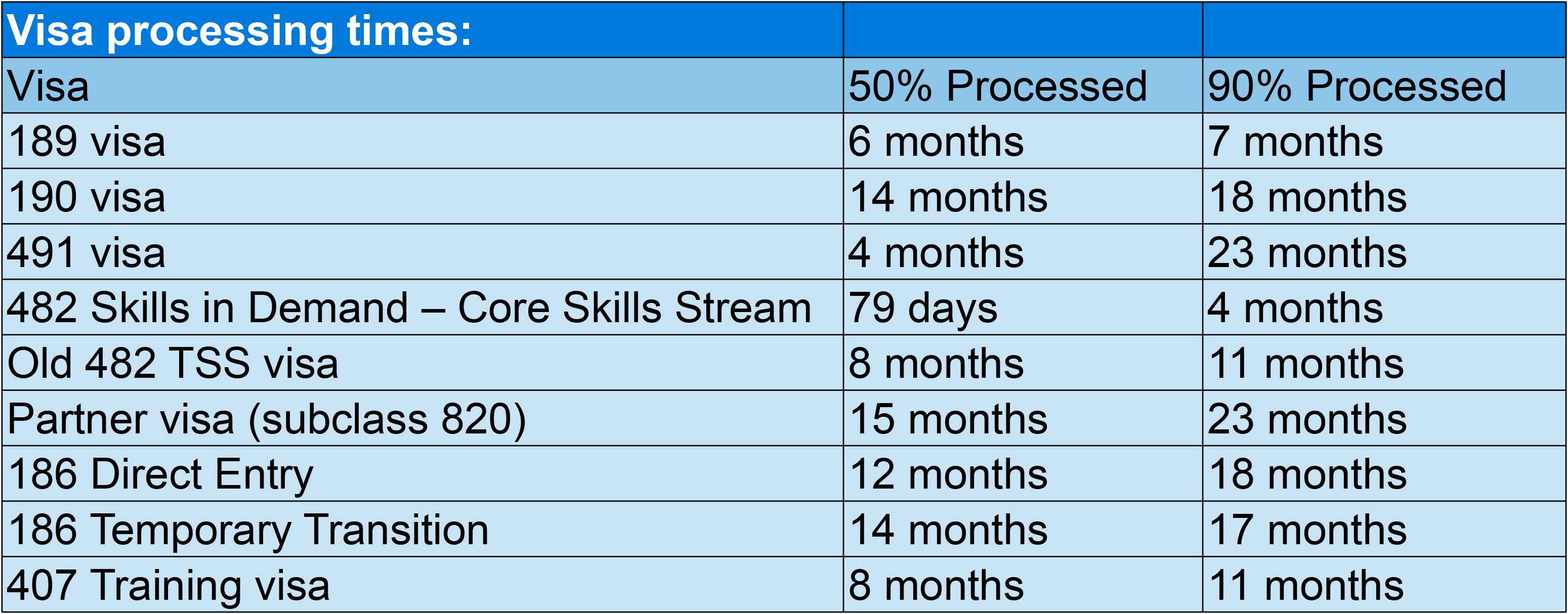
Processing times are one of the most discussed aspects of the migration process, and we understand how frustrating it can be when they become longer.
The Department of Home Affairs has recently updated its visa processing times. In the table below, you will find some of the main visa subclasses and the typical timeframes for processing.
Keep in mind that your visa may be finalised earlier than the published timeframe — particularly if your occupation is in high demand. However, it may also take longer if your case is more complex or if there are issues such as inconsistencies in your application or documentation, or health and character concerns.
Delays in Relationship Registration
To lodge a partner visa, many applicants choose to strengthen their application by registering their de facto relationship.
In South Australia, this process usually takes just over 28 days. However, current timeframes have extended to approximately two to three months due to a processing backlog.
One possible explanation for this delay is an increase in partner visa applications, potentially driven by the temporary closure of the skilled visa programs, including the Subclass 189, Subclass 190, and Subclass 491.
Final Advice for Visa Applicants
While we await the Migration Planning Level announcement, skilled visa applicants should use this time to:
Prepare their skills assessment and English test results
Gather all required employment and qualification evidence
Monitor program opening dates closely
Contact an immigration lawyer or migration agent to discuss their situation
If you need advice on your Australian visa application, contact us for a consultation. Since 2011, we have assisted thousands of individuals and businesses with their migration needs.
Australia’s National Innovation Visa (NIV) – Subclass 858 is designed to attract talented entrepreneurs, researchers, and business people from around the world to contribute to the country’s innovation-driven economy.
The NIV is an Australian permanent residency visa for internationally recognised individuals with exceptional talent. If the applicant receives nomination for the NIV from a state or territory, their chances of getting invited for the National Innovation Visa increase.
Why State Nomination Can Help You Secure a National Innovation Visa Invitation Faster
If a state or territory nominates you, you will have a better chance of being invited for the National Innovation Visa.
Under Ministerial Direction 112, those nominated by a state receive the second-highest priority. The highest priority is for those considered as global experts and international prize winners, such as Nobel Prize recipients.
The South Australian criteria include being able to demonstrate benefit to the South Australian economy and the ability to create jobs.
National Innovation Visa – South Australia State Nomination Criteria
South Australia is open, meaning you can apply for state nomination.
The South Australian criteria include the opportunity to provide evidence of current employment in South Australia, or a job offer with a salary at or above the Fair Work High Income Threshold (AUD).
The document checklist also includes the option of a support letter from a South Australian State Government agency referring you to submit a National Innovation Visa Registration of Interest (ROI) application.
So, having connections to South Australia is an advantage.
South Australia also rules out some types of investment activities, including cafés and restaurants, consulting firms, franchises, and buying existing businesses as these are not considered as ‘innovative’
South Australia has a Registration of Interest system (ROI). If your application progresses, you will be contacted by South Australia.
Their assessment process will include a panel interview of candidates.
National Innovation Visa – New South Wales State Nomination Criteria
The New South Wales criteria focus strongly on demonstrating benefits to New South Wales.
For the Entrepreneur Pathway – New South Wales wants "innovative and scalable business ventures with high growth potential for NSW".
For the Investor Pathway – New South Wales wants "innovative ventures, contributing to their success and the growth of the innovative ecosystem in NSW".
New South Wales will have their own seven-stage Expression of Interest (EOI) process. This will include, in stage 4, New South Wales seeking independent expert endorsement.
The New South Wales Government recently gave a presentation where they explained what the NIV is not for:
Not for passive investment
Not part of the Business Innovation and Investment Program (BIIP)
Not for vague or unsubstantiated ideas
Practical Considerations
For those seeking state nomination, the NIV will now be a 3-stage process:
State Nomination
Department of Home Affairs (DHA) Expression of Interest (EOI) – then, if invited
Visa application
Which State is Best for NIV Nomination?
The short answer: if you have a proven business track record or a collaboration lined up in a state, then that is the best state for you.
If you don’t have an existing relationship or collaboration with a state, it’s the perfect time to begin making that connection.
If you're planning to migrate to Australia under a skilled visa, one of the most important steps is to get your skills assessed by an approved authority. For many general professional occupations, that authority is VETASSESS. This blog will walk you through the process in a simple, easy-to-follow format to help you prepare, apply, and succeed in your skills assessment.
VETASSESS (Vocational Education and Training Assessment Services) is a leading skills assessment authority appointed by the Australian Government to assess the qualifications and work experience of applicants applying for skilled migration.
If your occupation falls into categories like business, education, arts, science, or administration, chances are that VETASSESS is your assessing body.
Step-by-Step Guide to VETASSESS Skills Assessment
1. Check Your Occupation Requirements
Before anything else, visit the VETASSESS website and look up your ANZSCO occupation code and title. This page will tell you:
What qualification level is required.
What fields of study are considered closely related.
How much and what type of work experience you need.
Each occupation is grouped into a category (A, B, C, D, or E), which influences how your qualifications and work history are assessed.
2. Make Sure You’re Eligible
You generally need:
A qualification at least equivalent to an Australian Diploma or higher.
At least 1 year of full-time post-qualification experience in the past 5 years.
Evidence that your work was paid and highly relevant to your nominated occupation.
3. Gather Your Documents
Here’s what you need to prepare:
Educational Documents:
Degree or diploma certificates
Full academic transcripts
Employment Documents:
Detailed employment references (on company letterhead)
Payslips, tax documents, or bank statements
Job descriptions or contracts
Identity Documents:
Passport (bio page)
Change of name documentation (if applicable)
If any documents are not in English, provide certified translations.
4. Choose the Right Assessment Type
VETASSESS offers two broad types of assessments:
General Occupations: Includes professions like marketing specialists, HR advisers, and policy analysts.
Trade Occupations: Includes electricians, cooks, hairdressers, etc.
Make sure you select the correct category that applies to your nominated occupation.
5. Create an Online Account
Go to the VETASSESS website and register for an account. Once registered, log in to start your application.
6. Submit Your Application
Complete all sections of the online form.
Upload your scanned documents.
Pay the application fee (from AUD $968 and up, depending on assessment type and urgency).
7. Wait for the Outcome
The standard processing time is usually 12 to 14 weeks. If you're in a hurry, you can pay an extra fee and opt for Priority Processing, which takes around 7–10 business days.
Once processed, you’ll receive an Outcome Letter that says whether your assessment is:
Positive – your skills meet the Australian standards.
Negative – your application didn’t meet the criteria (they will tell you why).
8. What Happens After a Positive Assessment?
With a positive outcome in hand, you’re ready to:
Lodge an Expression of Interest (EOI) in SkillSelect.
Always follow the official document checklist for your occupation.
Ensure all employment letters include the start/end dates, position title, duties, and hours worked.
Double-check translations and certification for non-English documents.
If you’re unsure, consult a registered migration agent or lawyer.
The VETASSESS skills assessment is a critical step on your migration journey to Australia. With proper preparation, thorough documentation, and a clear understanding of the process, you can submit a strong application that gets results.
Ready to get started? Head over to the VETASSESS portal and begin your assessment journey today! If you need any help, we can assist you with your Skills Assessment.
The Department of Home Affairs recently cancelled Kanye West’s Australian visa.
The reason for the cancellation is that the American rapper released a song referencing Hitler and promoting Nazism. He has also posted content on his social media accounts supporting Nazi ideology.
The song, released in May this year, was removed from most major music platforms shortly after publication.
This is not the first time Australia has considered blocking West. In 2023, Education Minister Jason Clare condemned West’s “awful” comments about Hitler and the Holocaust and suggested he could be denied entry.
The Minister for Immigration Tony Burke has made the following comments:
"He's made a lot of offensive comments that my officials looked at again once he released [that] song," he said.
"He's got family here … It wasn't a visa for the purpose of concerts. It was a lower-level [visa] and the officials still looked at the law and said if you're going to have a song and promote that sort of Nazism, we don't need that in Australia."
Kanye West’s Australian Family Connections:
West is currently married to Bianca Censori, an Australian citizen from Melbourne.
So the visa is likely to be a visitor visa, to allow visits to his wife’s family in Australia.
The Power to Cancel under the Migration Act include s116(1)(e) and s501
Under s116(1)(e) of the Migration Act the Minister for Immigration has wide powers, often referred to as God powers.
They can cancel a visa if:
“the presence of its holder in Australia is or may be, or would or might be, a risk to:
(i) the health, safety or good order of the Australian community or a segment of the Australian community; or
(ii) the health or safety of an individual or individuals; or “
There are also wide powers under s501 part (2) and (3) to refuse and cancel visas if based on not satifiying the character test.
These include:
501(6) For the purposes of this section, a person does not pass the character test if:
(iii) vilify a segment of the Australian community; or
(iv) incite discord in the Australian community or in a segment of that community; or
(v) represent a danger to the Australian community or to a segment of that community, whether by way of being liable to become involved in activities that are disruptive to, or in violence threatening harm to, that community or segment, or in any other way; or
The song Heil Hitler could be seen to vilify parts of the Australian community, incite discord and to encourage disruptive and violent activities to a community.
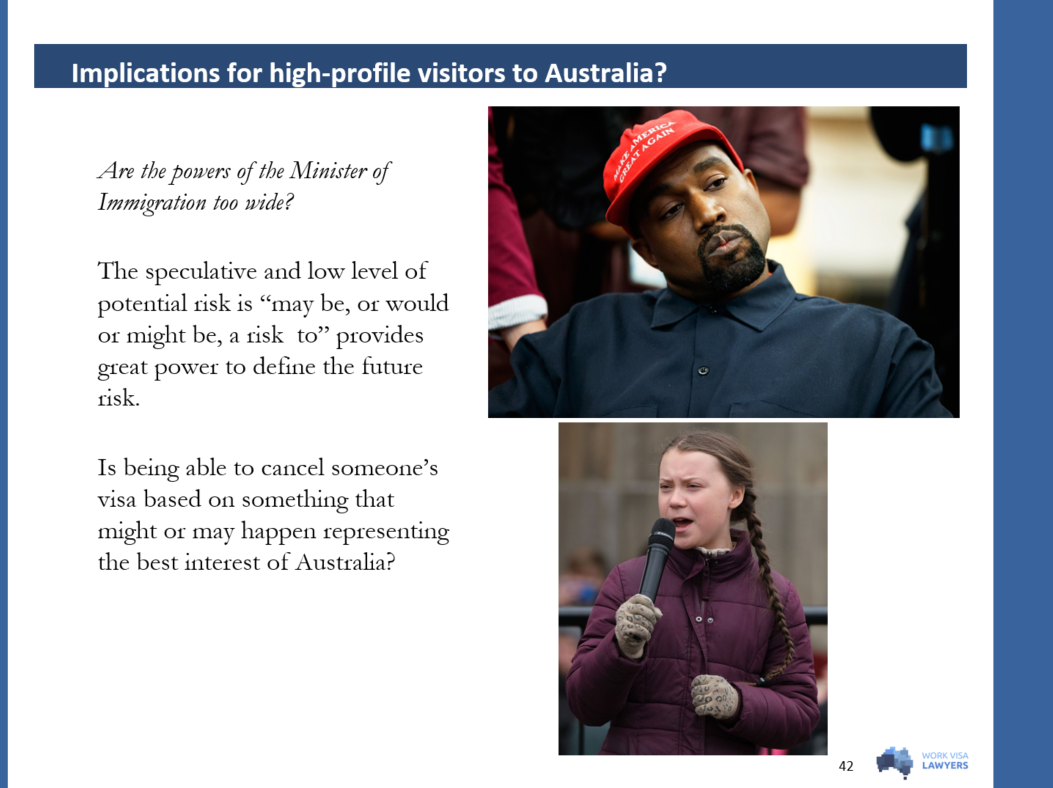
We Predicted this Might Happen to Kanye West – back in 2022:
In an article we published in 2022 in relation to the cancellation of Tennis superstar Djokovic’s visa, we made the following observations.
And we included pictures of Kanye West and also of Greta Thunberg.
If you hold an Australian visa and have social media – be careful:
So, be careful what you publish on social media and other platforms.
The cancellation powers could be applied to you. Your visa could be cancelled if your posts could be seen to be a risk to a community in Australia or to encourage disruptive activities or violence. Australia is not the only country that may check your online activity. For example, the United States requires social media information when you apply for a visa — and they may review it.
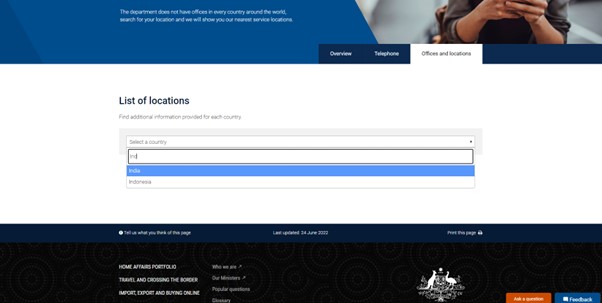
The Department of Home Affairs requires police clearances from any countries in which the person (aged 17 or older) has spent 12 months or more in the last 10 years since turning 16 years old.
For those who have recently lived in many countries, this can mean collecting a few police clearances, while for other people who have lived only in their home country may require less.
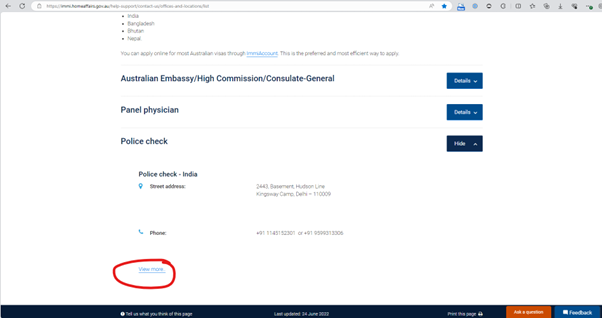
Step 3 - Search the name of the country for which you are looking for police clearance guidance in the box.
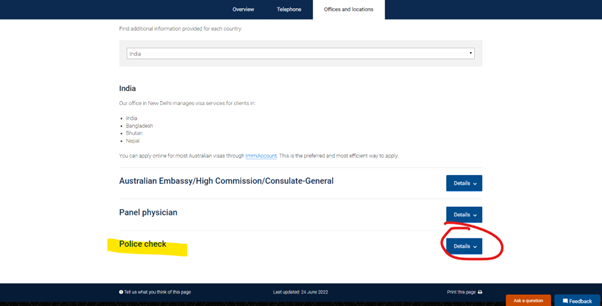
Step 4 – Click details to expand the “Police clearance” tab
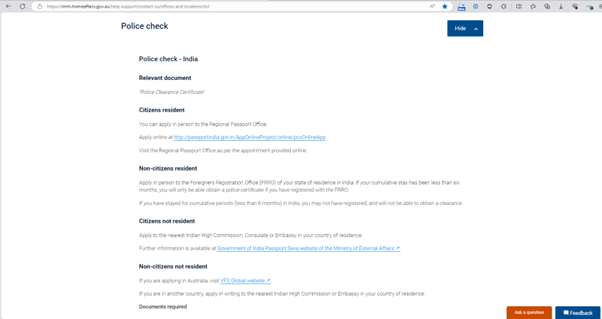
Step 5 – Click “View more” to expand for the actual guidance (the information available at first is very limited)
Step 6 – Identify the section that applies to you
Many countries have different processes for citizens and non-citizens, and different processes for applying from in the country or from outside the country.
Our top tips for applying for police clearances:
Some countries take longer than others, be sure to plan ahead – delays in police clearances can often delay a decision on your visa
Be careful selecting third parties – in some countries, third parties are necessary to obtain your police clearance, while in Australia often using a third party can lead to getting the wrong police clearance and needing to apply again
Ensure you get all the clearances you need – for many countries, such as Brazil or the United States, you would need to get more than one police clearance: usually a federal and a state police clearance
We’ve recently seen a growing number of inquiries about 188 Business Innovation and Investment visa extensions. This trend is largely due to disruptions caused by COVID-19, which delayed business development and made it harder for some visa holders to meet the criteria for the 888 Permanent Residency visa.
A 188 Business visa extension allows eligible holders of the Business Innovation stream to extend their stay in Australia. This additional time gives them the opportunity to meet the requirements for the subclass 888 visa, which is the permanent residency pathway.
Why Might You Need a 188 Visa Extension?
Many applicants request an extension because they haven’t yet met the 888 visa criteria, such as business turnover, asset requirements, or operational timelines. An extension gives them the time they need to continue growing and managing their Australian business.
Who Can Apply for a 188 Business Visa Extension?
You may be eligible to apply if you:
Hold a subclass 188 Business Innovation stream visa
Are actively managing a business in Australia
Have a main ownership interest in one or two Australian businesses
Maintain daily involvement in the business operations
What’s Involved in the Extension Process?
The extension process involves two key stages:
State Nomination – You must first obtain nomination from the relevant state or territory government.
Visa Application – Once nominated, you can lodge your extension application with the Department of Home Affairs.
Key Requirements for the 188 Visa Extension
You must hold a valid 188 Business visa
Reside in Australia and be actively managing your business
Demonstrate continued business activity and growth
Provide strong supporting evidence of business operations
Secure state or territory nomination before applying
Who Typically Applies?
We’ve recently helped clients from Vietnam, China, and Bangladesh successfully extend their 188 Business visas. These extensions have allowed them to remain in Australia while continuing to build their businesses toward permanent residency.
See below for some examples of when a business can request a 188 visa extension:
Property Developer needing more time:
Property Development – A property development business experienced significant delays in commencing operations due to prolonged council approval processes. The extended timeline disrupted the business’s projected milestones, the business owner was not able to complete the construction and sell the properties. The business owner is now seeking an 188 Visa Extension to allow more time for the business to become eligible and meet the 888 visa’s criteria.
Small Business Owner needing to increase turnover:
Small Business - A 188 visa holder established a restaurant on their arrival. During the COVID-19 pandemic, the mandatory closures and reduced customer capacity significantly impacted revenue, making it difficult to meet the turnover required for a 888 permanent visa. The business owner is now seeking an 188 Visa Extension to allow at least two years for the business to become eligible and meet the 888 visa’s criteria.
Australia Produce Exporter with more planned shipments:
Wine Export – A wine export business was established after the applicant's first arrival of the 188 visa. However, in 2020, China imposed significant tariffs (up to 212%) on Australian wine imports as part of broader trade tensions. This made the business model unsustainable, as profit margins disappeared, and Chinese buyers turned to alternative suppliers. The applicant has to change their business plan and need additional time to demonstrate that the new business model was viable and met visa requirements. A 188 extension visa will be their best option.
Need Help with a 188 Business Visa Extension?
If you or someone you know needs to extend their 188 Business visa, don’t wait until the last minute. Early preparation is essential to ensure a smooth process.
Contact our team today for tailored advice and support with your extension and your pathway to permanent residency.
From 1 July 2025, income thresholds for skilled visas will increase by 4.6%, in line with updates to the Average Weekly Ordinary Time Earnings (AWOTE). These changes deliver on commitments outlined in the Australian Government’s Migration Strategy and reflect recommendations from the Migration Review.
This annual indexation ensures that wages for skilled migrants grow in step with Australian earnings—helping to prevent skilled migration from being used to undercut local workers.
For nomination applications lodged on or after 1 July 2025, employers must offer a salary that meets or exceeds the new threshold or the annual market salary rate —whichever is higher.
These changes do not apply to:
Existing visa holders, or
Nominations lodged before 1 July 2025.
High Income Threshold Updates
The High Income Threshold will also raise from 1 July 2025:
Current: $175,000
New High Income Threshold (from 1 July 2025): $183,100
The High Income Threshold is one of the factors that may be used to assess the applicant's exceptional and outstanding achievements.
Federal Election: What Does It Mean for Immigration?
Anthony Albanese was re-elected on 5 May, and with this result, we expect the Migration Strategy announced by Labor in December 2023 to continue. This includes proposed reforms to the points test for the 189 visa, 190 visa, and 491 visa, as well as potential changes in regional migration.
The Prime Minister has also announced the composition of his new ministry, with no major changes in the Immigration and Citizenship portfolio:
Tony Burke MP remains the Minister for Home Affairs and Minister for Immigration and Citizenship.
Next 189 Invitation Round
Many people are asking when the next 189 visa invitation round will take place. We believe it may be around August or September, as we’re nearing the end of the financial year.
The Temporary Skilled Migration Income Threshold (TSMIT) or Core Skills Income Threshold (CSIT) is increasing from $73,150 to $76,515 on 1 July 2025.
This affects new applications for the 482, 186, and 494 visas.
This change may make it harder for occupations like Chefs and Childcare Workers to be sponsored, as their salaries often fall below the new threshold.
Visa Application Fees Increasing
Visa fees will also increase from 1 July 2025 — as they do every financial year.
If you want to avoid higher application costs, consider lodging your visa before 1 July.
Student and 407 Visa Refusals Increasing
Student Visa Refusals:
According to recent data, of 39,594 appeals lodged with the ART in early 2025, 24,131 were student visa refusals. The likely explanation is that Student visa refusal rates have risen due to new government efforts to reduce net migration.
To improve your chances, make sure your application reflects that you meet the genuine student criteria.
The 407 Training Visa is also seeing more refusals. Previously, around 92% of 407 visas were granted, based on a Freedom of Information request from late 2024 — but that has now changed.
The issues could be with any of the three stages of the Training visa: Sponsorship, Nomination, and Visa.
Refusals may be due to:
Not being a genuine training applicant (e.g., applying only because a Graduate Visa isn’t an option)
No clear training plan
Appeal options may vary with the 407 Training Visa.Sometimes there is the ability to appeal to the ART, however, there may be circumstances where there is no path to appeal.
Seek tailored advice if planning to apply for a Training Visa.
188 Visa Extension
We’ve received an increasing number of inquiries about 188 visa extensions. This is mostly due to COVID-19 disruptions and delays in business progression.
Some visa holders now need more time to meet the criteria for the 888 Permanent Residency visa.
If you or someone you know is seeking an extension, remember:
You’ll need strong evidence of business activity
You’ll also need state sponsorship
Don’t leave it to the last minute — preparation is key.
Visa Processing Times
In recent months, we’ve heard concerns about delays in visa processing. Here are the current average times:
Visa Type
50% Processed In
90% Processed In
TSS 482 visa (old stream)
5 months
8 months
Skills in Demand 482 visa (Core Skills)
43 days
84 days
PR 190 visa
18 months
21 months
491 visa
20 months
22 months
191 visa
5 months
12 months
820 Partner visa
15 months
32 months
801 Partner visa
8 months
17 months
Do you need help with you visa application?
If you need assistance with your visa application, contact our team at Work Visa Lawyers. We’re here to guide you through every step.
We’ve also had a big month at Work Visa Lawyers — including many 482 visa grants, a 494 visa grant, and our first National Innovation Visa invitation for a client in the health industry.
We also received multiple invitations for the 491 visa and 190 visa in South Australia, with a minimum of 65 points. We’ll list the different occupations and points later in this blog.
Federal Election – April Announcements Overshadowed by Trump Headlines
The federal election has been scheduled for 3 May 2025. Voting is compulsory for Australian citizens, and the results will shape immigration policy over the next three years.
However, the spotlight has been somewhat stolen by US President Trump, who announced tariff changes on 2 April 2025. His headlines have dominated the news cycle since.
Still, there are key policy announcements from both major parties.
Coalition Announcements
Peter Dutton, Leader of the Opposition, has proposed:
A reduction of 80,000 student visas
Increased student visa fees
A review of the Subclass 485 Graduate Visa
He stated:
“Student visa application charges will also rise to $5,000 for Group of Eight universities and $2,500 for other international students.”
This is a major increase from the current $1,600 fee.
He also proposed a $2,500 fee to change education providers, and a referendum to allow deportation of dual citizens convicted of crimes in Australia.
Dutton also plans to reduce Australia’s net overseas migration by 100,000, down from the current level of 185,000.
Labour Response
The Labour government has criticised these proposals as “savage cuts”, warning they would impact key sectors such as construction, aged care, and tourism, which rely heavily on skilled migrant workers.
If re-elected, the Albanese Labour government is expected to maintain similar migration levels to those currently in place.
Early polling suggests a likely Labour victory — meaning temporary visa holders in Australia may not need to stress over Coalition policies just yet. We’ll cover the final election results and immigration impacts in our May 2025 update.
Global and Economic Context – Are We Cutting Golden Gooses?
With Trump’s tariffs shaking global trade, recession concerns are rising. During recessions, Australia relies on sectors that bring investment and jobs, such as:
International students (a major export and local employer)
Business and investor visa programs
However, these very visa streams are being reduced or cut entirely. Is Australia killing off its goose that lays golden eggs?
Perhaps it’s time to reconsider.
482 Visa Updates
The Subclass 482 visa has no caps on numbers, making it an attractive option for skilled workers and graduates frustrated by slow invitations for 189, 190, or 491 visas.
Nomination Refusals Increasing for Chefs and Cooks
There’s been a rise in nomination refusals for chefs and cooks in pubs and restaurants. Reasons cited by the Department of Home Affairs include:
Failure to meet Labour Market Testing (LMT)
The decision maker believes the position is not genuine
We’ll continue monitoring this and keep you updated.
482 Nomination & Visa Processing Delays
The Migration Institute of Australia (MIA) recently wrote to Minister Tony Burke and Assistant Minister Matt Thistlethwaite MP regarding the slow processing times for 482 visas (both the former Temporary Skill Shortage and current Skills in Demand).
We’ll share any updates as they come.
482 and 494 Work Conditions Clarified
The Department of Home Affairs has confirmed:
Subclass 482 visa and 494 visa holders who stop working for their original sponsor but have lodged a new nomination do not need to stop working for the new sponsor, even if the 180-day limit under Conditions 8607(5) or 8608(5) has passed.
This means applicants can continue working with that new employer while waiting for their new nomination to be processed.
DAMA Updates
The Far North Queensland DAMA has been updated with 51 new occupations.
The Orana DAMA (NSW) has been extended by 12 months.
A new DAMA has been approved for the Northern Territory.
For more information, visit each region's official DAMA site.
Property Ban for Foreign Buyers
From 1 April 2025 to 31 March 2027, temporary residents and foreign-owned companies are banned from purchasing established properties in Australia — including houses, apartments, and units — unless an exception applies.
A review will determine whether this ban will be extended beyond March 2027.
407 Training Visa Refusals
There has been a significant increase in Training visa refusals compared to last year, when 92% were approved, according to Freedom of Information data from the Department of Home Affairs.
In some cases, no appeal is available. If you're applying for a 407 visa, ensure you meet all requirements and have a clear, structured training plan — or consider visa options that allow for appeal.
State Nomination Updates – 190 & 491 Visas
Tasmania
491 visa (Overseas Applicant – Job Offer) pathway is closed for the rest of the 2024–25 program year
190 visa (Health Sector Job Offer) pathway remains open
Visa Stats as of now:
190 visa: 1,403 of 2,100 nominations used (298 ROIs on hand)
491 visa: 513 of 760 nominations used (275 ROIs on hand)
Over 89% approval rate for applications processed this year
If you're in Tasmania and meet the criteria, your chances are strong.
South Australia
Our clients recently received invitations under South Australia’s program:
Early Childhood Teacher – 70 points (190 visa)
Community Worker – 70 points (190 visa)
Registered Nurse – 65 points (190 visa)
Project and Programme Administrator – 75 points (190 visa)
Finance Manager – 70 points (491 visa)
ICT Customer Support Officer – 75 points (190 visa)
There have been a lot of questions and speculations as to how difficult it is to get an invitation considering the factors mentioned in Ministerial Direction No 112. Is it harder to get an invitation for the NIV compared to the Global Talent Visa?
When there is a lack of intormation sometimes the best thing to do is an Freedom of Infomatoin request to the Australian Government.
We thought of asking the Department of Home Affairs, how many Expressions of Interest (EOIs) have been submitted and how many have received an invitation since the introduction of the National Innovation Visa?
How Many EOI submitted for the NIV so Far?
We received a response from the Department regarding our request and the Department advised that as on 21 March 2025 they have received a total of 3510 NIV EOIs and they have issued a total of 70 NIV invitations.
Only 70 invitations for the National Innovation Visa since December last year. That seems like a low number!
Which means that only about 2% have received an invitation.
The top 3 priority sectors are:
Critical technologies with 834 EOIs received;
Health Industries with 554 EOIs received; and
Financial Services and FinTech with 372 EOIs received.
Renewables and low emission technologies – 9 invitations.
We recently received an invitation to apply for the National Innovation Visa for one of our clients who worked in the Health Industries sector. Please check our Instagram video for more information about the invitation.
Critical technologies are those technologies that were identified by the Australian government which can impact Australia’s national interest including the country’s economic prosperity, national security and social cohesion. These include the fields of:
advanced manufacturing and materials technologies
artificial intelligence (AI) technologies
advanced information and communication technologies
quantum technologies
autonomous systems, robotics, positioning, timing and sensing
biotechnologies
clean energy generation and storage technologies.
Health Industries
Health Industries is not just any person working in Health. They are looking for specialisations such as:
antimicrobial resistance
artificial intelligence in health
biochemistry and cell biology
biotechnology
genomics
emerging health threats and emergencies
health economics
implantable and wearable devices
infectious disease prevention
pharmaceuticals and precision medicine
medical science manufacturing for therapeutic products.
Renewables and low emission technologies
They are looking for the following specialisations:
bio-methane production
circular economy innovations
clean energy technology
emission reduction and carbon storage
green metals
low-carbon liquid fuels
processing and refining of critical minerals
renewable energy generation
transmission, distribution or storage
renewable hydrogen
Waste to Energy (WtE) technology.
It is not surprising that the top sectors are Critical technologies, Health Industries and FinTech as in addition to EOI candidates who work in these sectors there are also a number of Digitech talents who have specialisations in these sectors who can submit an EOI under these sectors now that pure Digitech has been removed as a priority sector.
Why are the Invitations So Low for the NIV?
However, despite having the third highest EOIs received, there are no invitations extended in the Financial Services and FinTech sector. This could be because this sector is a Priority four Tier 2 sector.
It is also interesting to note that there are less than 5 invitations extended to those in the arts and less than 5 invitations for those in the sports. As Arts and Sports are not included in any priority sectors those that got the invitation would have been ‘recipients of international ‘top of field’ level awards.’
As there are less than 3 months left before the end of the current financial year and some of the places are already used up by the Global Talent Visa applicants, there are not a lot of places left and most of the EOI candidates can expect to wait longer to see if they will get an invitation.
Next Big Opportunity for the NIV New Allocations from 1 July 2025:
The next allocation for the NIV will be from the 1 July 2025. This will be a big opportunity because the Global Talent Visa is now shut. So all the allocations from the 1 July 2025 will need to go to the NIV.
So there is a strong incentive to get your EOI for when the new allocations open from the 1 July 2025, to give you the best chance of getting an invite.
Try Our Free Assessment for the National Innovation Visa Here:
Getting the information from the Department is useful. It provided us with some insight regarding the popular sectors and it is good to know that invitations are still being issued even if there are just a few at the moment.
Since the Department of Home Affairs released the new National Innovation Visa (NIV), replacing the Global Talent Visa in December 2024, we have been receiving many inquiries about this new visa.
The National Innovation Visa is a permanent residency visa designed for exceptionally talented individuals from around the world, including global researchers, entrepreneurs, innovative investors, athletes, and creatives.
We have a service page and a YouTube video explaining more about the National Innovation Visa and also offer a free assessment on our website, where our team can provide you with an evaluation of your eligibility.
In this blog we will discuss some of the main questions we are receiving about the National Innovation Visa.
Who is eligible to apply for the National Innovation Visa?
Applicants must demonstrate exceptional and outstanding achievements in one of the targeted sectors, such as critical technologies, education, health, energy, infrastructure and transport, or research or has exceptional and outstanding achievements in sports or the arts.
How is the process to apply for the National Innovation Visa?
High-talent individuals must submit an Expression of Interest (EOI) to the Department of Home Affairs and obtain a nomination from an Australian citizen, permanent resident, or organization. If the applicant receives an invitation, they can apply for the National Innovation Visa.
Is there an age limit for applicants to apply for the National Innovation Visa?
There is no age limit to apply for the National Innovation Visa. However, applicants under 18 or over 55 may need to demonstrate how their work will provide exceptional benefit to Australia.
Do I need a job offer to apply for the NIV?
A job offer is not necessarily required. The focus is on the applicant's achievements and potential contributions to Australia. However, having a job offer in Australia for a job that has a salary equal to or more than the Fair Work High Income Threshold will help.
Do I need a nominator?
Yes. You need a nominator to attest to your achievements and expertise. The nominator can be a state or territory government, an Australian company, or an Australian citizen or permanent resident who is also an expert in your field.
What are the visa costs for the National Innovation Visa?
The visa application fee for the main applicant of the National Innovation Visa in the 2024-2025 financial year is AUD 4,840. For dependents over 18 years old, the visa fee is AUD 2,425, and for dependents under 18 years old, the visa fee is AUD 1,210.
The fees increase every new financial year.
Additional costs, including translation for documents, police clearances, medical exams, and immigration lawyers or agents’ fees, may apply as extra expenses.
What are the English language requirements?
Applicants aged 18 years or older must demonstrate at least 'Functional' English, which is 4.5 in IELTS and 30 in PTE. If this requirement is not met, a second visa application charge applies.
Can I bring my family with me?
Yes, the visa allows applicants to include immediate family members, such as spouses and dependent children, in their application.
What is the processing time for the visa?
Processing times vary based on the complexity of the application and the applicant's specific circumstances. If it follows the same processing time as the Global Talent Visa, the visa will likely take between 6 to 12 months to receive a decision.
How can we assist you in applying for the National Innovation Visa?
Australian Federal Election and Immigration – Policy Preview for Major Parties and Independents
If the current Labor government wins, it is expected to continue with the following policies:
Maintain migration allocation levels similar to 2025, which is 185,000 visas for that year.
Continue with migration strategy reforms, which were announced in December 2023. This may include a review of the points-based system for GSM visas, including the 189, 190, and 491 visas.
Following consultation in 2024, release plans for regional visas.
No business or investor visas are planned to be available.
Recently, in Direction 114, the current government assigned the lowest processing priority to the Significant Investor Visa (SIV).
This demonstrates that the government is not interested in investor visas or even prioritizing the processing of SIV applications. This will be disappointing for those with applications still in the processing backlog.
If the Liberal Party and a potential coalition government win:
Liberal leader Peter Dutton has previously stated that he would cut the migration allocation to approximately 140,000 per year.
In contrast to Labor’s stance, Peter Dutton has expressed support for reintroducing the Significant Investor Visa (SIV).
This contrasts with the Albanese government, which abolished the Significant Investor Visa, closing it from 1 July 2024.
When the Skills in Demand 482 Visa was introduced, processing times were promised to be just 7 days.
However, that has not lasted. The Department of Home Affairs has now updated processing times:
50% of applications are processed in 30 days
90% of applications are processed in 47 days
Please remember that processing times refer to the time taken to reach a decision—not necessarily a positive one. Many businesses and applicants choose to work with migration professionals to maximize their chances.
One of the most common questions we receive is: How do I find a sponsor?
We have created a video and website page explaining the best ways to find a sponsor.
Pacific Engagement Visa Updates
The Pacific Engagement Visa aims to bring 3,000 workers per year from Pacific nations and Timor-Leste to Australia. However, it is currently facing major delays, leaving many hopeful applicants disappointed.
The program was launched last year and operates through a ballot (lottery) system for permanent residency.
Over 56,000 people applied, but less than 5% of available visas have been allocated after five months.
Many applicants who invested time and money are now frustrated with the lack of updates from the government.
Another major challenge is securing a job offer, as it is difficult to do so without already having a visa.
Over 50,000 registrations of interest have been received for just 3,800 available places in the 2024-2025 financial year.
This year’s program is more competitive than last year when SA received 12,000 registrations of interest.
Half of the allocation has already been filled.
Most invitations have been issued to onshore applicants.
Registrations are still being accepted, and invitations will be issued until June 2025.
English language skills and work experience are key selection criteria.
High priority occupations include construction, teaching, health, defence, space, and cybersecurity.
There is a high demand for applications from medical diagnostic radiographers, sonographers, podiatrists, floor finishers, glaziers, electricians, roof tilers, plumbers, ambulance officers, and cabinetmakers. If your occupation is one of those just mentioned, you may have a better chance to be invited.
If you have submitted an Expression of Interest but have not received an invitation, you may still have a chance—especially if you are in a high-priority sector, as half of the allocation is still available.
However, due to high competition, you may want to consider other visa pathways, such as employer sponsorship or a partner visa if you have an Australian Permanent Resident or Citizen partner.
Contact us:
We are one of the largest Australian immigration law firms, assisting thousands of individuals and businesses since 2011. You can book an appointment by clicking the button below.
In case you missed it, the internet is buzzing about the news and video of an American influencer who took a baby wombat from its mother.
What she (probably) initially thought was a good idea to get more views for her social media accounts may now be the reason for her to get deported out of Australia.
The now-deleted video showed Sam Jones snatching a joey wombat from its mother and carrying it to a car while a man can be heard laughing in the background while filming Ms Jones.
This video has now come to the attention of Australian Federal Government top officials including Prime Minister Anthony Albanese and the Home Affairs Minister Tony Burke.
Ms Jones who according to her social media describes herself as “wildlife biologist and environmental scientist” was in Australia reportedly on a Visitor Visa. We are not sure exactly what subclass of visa she had.
The incident prompted a backlash among the Australian public and now the Australian government is reviewing whether she breached the conditions of her visa.
It is now reported that while her visa is under review, Ms Jones has now left Australia.
Reasons for cancellation?
What are the reasons for the Home Affairs Minister to cancel her visa?
Breach of Visitor visa conditions
Visitor visa comes with certain conditions including work restrictions (condition 8101). Visitor visa holders can not work while in Australia. If by making the video with the aim of getting more views and earning money from it, Ms Jones may found to be “working” and may be found in breach of condition 8101.
General visa cancellation grounds
The Home Affairs Minister has broad visa cancellation powers including a non-delegable personal powers to cancel a visa on character grounds under s501of the Migration Act.
If Ms Jones is found to have breached wildlife protection laws or animal welfare laws, then she can potentially be found to breach the character requirement for Australian visa holders.
The Minister also has the power to cancel visas under s116 of the Migration Act, that is, if the Minister is satisfied that it is in the public interest to cancel the visa.
Some may remember what happened to a certain famous tennis player, Novak Djokovic, back in January 2022 where the Minister cancelled his visa invoking s116 on the ground that Djokovic’s presence in Australia is or may be, or would or might be, a risk to the health, safety or good order of the Australian community or a segment of the Australian community.
It is possible that the Minister may exercise this power again.
It can be argued by the Australian government that the action of Ms Jones, considering that she is an ‘influencer’ and may have a number of followers there is a possibility that she or her actions will encourage this kind of behaviour and will endanger Austrralian protected species and therefore there it is against the good order of Australian society.
Effect of cancellation when she already left Australia?
Would a cancellation even affect her Australian visa status now that she has voluntarily left Australia? Some would say that reviewing and subsequently cancelling Ms Jones’s visa will be useless.
If a visa is cancelled under s116 of the Act, the visa holder faces a 3-year ban pursuant to public interest criteria (PIC) 4013 and 4014 of the Migration Regulations 1994 from applying for a further Australian visa due to the cancellation under s116.
Home Affairs Minister Tony Burke is quoted as saying that "Either way, given the level of scrutiny that will happen if she ever applies for a visa again, I’ll be surprised if she even bothers.”
Which does not bode well for Ms Jones.
Broader Implications
Effect of the upcoming Australian Federal Elections
Just like in the case of Djokovic which happened during a federal election year (2022), this incident with Ms Jones also happened during a time when a federal election is scheduled to be held. Immigration is one of the key issues in the campaign and politicians want to be seen as being tough on immigration. They need to be seen as protecting the Australia and the Australian public.
Ms Jones can potentially be used as an example of how tough politicians can be on immigration. If visa holders do not want to be in this position, this is not the time to give the Australian government a reason to cancel your visa.
Implications of cancelling visitor visas
The video of the “influencer” may be distressing and considered by a lot of Australians as “appalling” but is her action enough to cancel her visa or ban her from Australia.
We have heard of Australian doing foolish acts while overseas, should other countries retaliate and cancel their visas too?
To apply for an Australian visa, your work experience can play a significant role. Both overseas and Australian employment can be considered, and the terms of employment do not usually matter, they can be casual, part-time or full-time, self-employed or as an employer.
Meeting work experience requirements for visas and skills assessments depend significantly on the facts and evidence of each person's particular case. Different periods of experience must be carefully examined to ensure the requirements can be met.
If you have overseas work experience, you can prove it using reference letters, payslips, bank statements, and other documents that confirm your occupation, duration of employment and salary.
If you are in Australia, your experience will count whether you work casually, part-time, full-time, or under an ABN or TFN.
Here are some visas that require relevant employment experience:
1. General Skilled Migration Visas (Subclass 189, 190, and 491)
These visas are for individuals with skills that are in demand in Australia.
Work experience requirement: Post-qualification, relevant work experience is often required for a skill assessment. The more experience you have, the more points you can claim in the points-based system.
How it counts: Only work that exceeds 20 hours per week can be counted. Full-time, part-time, casual, and self-employment can all count as long as the work is relevant to your nominated occupation.
Each state has different criteria regarding the required number of work hours and whether the applicant must be living in the state or not.
Besides work experience, you will need to meet additional requirements to submit an Expression of Interest (EOI) for the 189 visa, 190 visa, or 491 visa.
2. Skills in Demand Visa (Subclass 482)
The 482 visa allows employers to sponsor foreign workers for skilled roles.
Work experience requirement: At least one year of full-time experience in the nominated occupation.
Part-time or casual experience can also be counted and will be calculated pro rata. For example, if you work part-time (20 hours per week) for two years, it will be equivalent to one year of full-time experience.
ABN experience may also count if the applicant has sufficient documentation to support it.
How it counts: The work experience should show you have the necessary skills for the job you’re being sponsored for. The employer will need to verify your experience as part of the sponsorship application.
3. Employer Nomination Scheme Visa (Subclass 186) Direct Entry Stream
The 186 Direct Entry Visa is a visa for skilled workers nominated by an employer sponsor that leads directly to permanent residency.
Work experience requirement: You need at least 3 years full-time of relevant work experience. Generally, the experience needs to be post-qualification.
How it counts: Similar to the 482 visa, your experience needs to be in the nominated occupation and directly related to the role.
Part-time or casual experience might be considered, but it could be prorated depending on the hours worked.
ABN experience may also count if the applicant has sufficient documentation to support it.
4. Skilled Employer Sponsored Regional Visa (Subclass 494)
The 494 visa is for skilled workers nominated by their employer to work in regional areas in Australia.
Work experience requirement: You need at least 3 years full-time of relevant work experience. Generally, the experience needs to be post-qualification.
How it counts: The experience needs to be in the nominated occupation and directly related to the role.
Part-time or casual experience might be considered, but it could be prorated depending on the hours worked.
ABN experience may also count if the applicant has sufficient documentation to support it.
5. Training Visa (Subclass 407)
The Training Visa allows applicants to undertake structured workplace-based training in Australia to improve their skills or meet licensing/registration requirements.
You must have at least 12 months of relevant work experience in your occupation within the last 24 months before applying. The experience can also be studying.
The experience can be full-time or part-time, but it must be directly related to the training program you are applying for.
Volunteer work may be considered if it is structured, documented, and relevant to the training.
Foreign investors will soon be banned from purchasing established homes in Australia as part of the Albanese government's efforts to ease pressures in the housing market.
From 1 April 2025 to 31 March 2027, foreign buyers, including temporary visa holders and foreign-owned companies, will no longer be allowed to purchase existing homes, except in limited cases.
These limited exceptions will apply to investments that substantially boost housing supply or enhance housing availability, as well as those related to the Pacific Australia Labour Mobility (PALM) scheme.
The Albanese Government states the goal of the ban is to reduce competition in the housing market and increase homeownership opportunities for Australians.
The government will review the ban in 2027 to decide whether it should be extended.
How Will This Impact Temporary Residents?
Currently, temporary residents are allowed to buy one established home if they use it as their primary residence. Under the new rules, many long-term temporary visa holders, such as those on 491 visa or 494 visa, will now face major restrictions on property ownership.
This change may increase demand for rental properties, as temporary visa holders who previously would have purchased homes will now compete for rentals instead.
What Do These Changes Mean for Foreign Investors?
The new policies will make it more expensive and difficult for foreign investors to buy property in Australia, particularly established homes. However, investing in new developments that contribute to housing supply may still be possible under certain conditions.
The government states the two-year ban is designed to prioritise homeownership for Australians while ensuring that foreign investment benefits the housing market. With stricter regulations and higher fees, these changes are expected to impact property prices, rental markets, and investment trends.
February brings crucial updates and important discussions on Australian immigration. In this blog, we cover the latest visa changes and answer some of the main questions that we have been receiving.
A 491 visa for a Registered Nurse in South Australia
A 491 visa invitation with 70 points for a Swimming Instructor in South Australia
189 Visa Invitation Round: What to Expect
The federal government does not have a fixed schedule for 189 visa invitation rounds, but trends can be identified based on planning allocations and previous rounds.
Given that the planning level for the entire year ending June 30, 2025, is 16,900 places, there may not be another round or, at best, a small, targeted round focusing on construction trades and healthcare occupations.
Why Have There Been No 491 Family-Sponsored Visa Rounds?
The past three invitation rounds have issued zero invitations for the 491 Family-Sponsored visa.
While this visa is designed to allow skilled migrants to live with relatives in regional areas, the government has chosen not to allocate invitations.
Given the low number of invitations over the past two years, individuals interested in this pathway should explore alternative options, such as state-nominated 491 visas or employer-sponsored visas.
Applications can now be lodged a few days before completing the two-year requirement to avoid the need for a new 482 visa.
Additionally, time spent on bridging visas between two 482 visas can now count toward the two-year work requirement.
Federal Election and Migration Policy Changes
Some journalists predict that the federal election will take place on or before May 17. A change in government typically leads to policy shifts, including migration reforms.
As soon as the government announces the election date, we will provide updates on potential impacts on immigration policy.
This visa, often referred to as the "Golden Visa," has been controversial in the past.
Additionally, the newly announced National Innovation Visa (NIV) includes opportunities for experienced angel investors. Those with a proven history of investing in startups may be eligible for the direct-to-PR 858 visa.
State and Territory 190 and 491 Visa Updates
Queensland
Queensland has used approximately 50% of its state nomination allocations and is prioritizing onshore 491 visa applicants. The 491 visa Small Business Owner program still has places available, though competition is high with 16,000 registrations of interest.
The Northern Territory has suspended new EOI applications for both the 190 visa and 491 visa, having already received enough to fill their total allocation for 2024-25.
The program will reopen once allocations for 2025-26 are confirmed, with new EOIs only accepted from applicants facing visa expiry or age-related eligibility issues.
Australian Capital Territory (ACT)
The ACT held a skilled migration nomination invitation round on January 30, 2025, issuing 230 nominations for the 190 visa and 314 nominations for the 491 visa.
Why Are Some States Closing Their Nomination Programs?
State allocations this financial year have been limited, and some states have already filled most of their available places.
The volume of EOIs received far exceeds the number of invitations states can issue. While EOIs remain in the system, most will not be invited.
Those who have not received an invitation should consider other visa options, such as employer-sponsored pathways.
Employer-Sponsored Visa Updates and Salary Challenges
The new Core Skills Occupation List (CSOL) now includes Child Care Workers, allowing them to apply for the 482 visa or 186 visa.
However, meeting the minimum salary requirement of AUD 73,150 remains a significant challenge.
Under the Children's Services Award, the Level 3.1 minimum annual salary is approximately AUD 53,679, making it difficult for most childcare centres to offer sponsorship. While some centres pay above award rates and may be able to sponsor a 482 visa, the salary threshold remains a significant barrier.
Similar challenges exist for other entry-level trade occupations, such as cooks and motor mechanics.
DAMAs are regional labour agreements that provide flexibility in age, salary, and English language requirements for employer-sponsored visas, including the 482 visa, 494 visa and 186 visa.
These agreements allow concessions, such as increasing the age limit to 55 years and setting salary requirements at AUD 65,838 or above.
In South Australia and Western Australia, the entire state is covered by DAMA agreements.
Recent DAMA visa grants in South Australia have included occupations such as sommelier and horticulture grower.
The full case details are available for review here.
Current Visa Processing Times
Many applicants are concerned about visa processing delays. However, compared to our analysis in September 2024, current processing times remain relatively stable. Here are some key processing times as of February 2025:
Many temporary visa holders are facing the end of easy renewal options, particularly for COVID-19 408 visas, Working Holiday visas, Student visas, and 485 Graduate visas.
The best next steps depend on an individual’s situation and skills.
If you need assistance exploring visa options or finding a pathway to permanent residency, our experienced immigration agents and lawyers are here to guide you.
Since 2011, we have helped thousands of applicants and businesses achieve their Australian immigration goals.
In this January immigration news blog, we’ll discuss what to expect in 2025, some of the latest visa news and tips to help you find the best pathway to Australian Permanent Residency.
Recent Visa Grants and Invitations
To begin, we would like to share some of our recent visa grants and invitations:
The federal election will happen this year in Australia. What could it change in relation to migration?
Federal elections are important because the Federal Government has the immigration powers and grants visas. Some media are reporting on the possibility of an April 2025 Federal Election.
The current Labour Government announced the Migration Strategy in December 2023, which includes a number of reforms. Some reforms are still pending, such as changes to the points for the 189 Visa, 190 Visa and 491 Visa.
There was a review of the point test discussion paper in April 2024 that opened a consultation process about reforming the points test. If the Labour government wins, you could expect these reforms to continue.
On the other hand, if the Peter Dutton-led Liberal Party were to win power, there are promises to cut Australian migration numbers.
Usually, a potential change of government would have much bigger effects on migration options and programs than fine-tuning processes and updating occupation lists.
At a practical level, if you’re eligible for an Australian visa under the current visa categories, changes could negatively affect your options. To put it bluntly, you may want to apply before any cuts or changes.
Many common occupations, including Enrolled Nurses and Cooks, can now apply directly for Australian PR. This is because the 186 Direct Entry Visa offers a direct path to PR and doesn’t require you to hold a 482 Visa for 2 years before applying for permanent residency.
The Federal Circuit Court recently found that there was apprehended bias by an AAT member against an Indian student.
The facts involved the refusal of a student visa to an Indian applicant who had applied to study commercial cookery. The AAT member made a number of comments during the hearing that demonstrated preconceived negative views.
Judge D Humphreys stated: “the Court is satisfied that the claim of apprehended bias is regrettably made out.”
Findings like this show you should always read the AAT transcript to consider in detail what happened at the hearing.
Occupation of Child Care Workers - Visa Updates
As many people already know, Child Care Workers can now apply for both the 482 Visa and 186 Direct Entry Visa. To apply for the 186 Direct Entry visa, the applicant must have a positive skills assessment.
The ACECQA is the skills-assessing authority for the Child Care Worker occupation and will be providing skills assessments for the full occupation, not just room leaders as previously.
Student Visa News
The proposed student visa cap legislation did not pass, so the Government has introduced Direction No. 111– Order for considering and disposing of offshore Subclass 500 Student Visa applications.
This provides offshore priority processing for student visas.
Priority 1 - Higher Priority
Student visa applications linked to providers in the higher education and vocational education and training sectors will be processed with higher priority if they have not yet reached their prioritization threshold, which is 80% of their 2025 expected allocation of new overseas student commencements, as per PRISMS data.
Higher priority processing will also apply to the following categories of students:
- School students - Non-award sector students, including short term exchange students - Standalone ELICOS students - Students enrolled with a TAFE Provider - Students enrolled in Pilot Training Courses - Students in postgraduate research courses - Foreign Affairs Students - Defence Students and students sponsored by the Commonwealth - Students with foreign government, Australian Government and state and territory scholarships that meet the criteria published on the Department of Education website as at the date this Ministerial Direction was made - Students from the Pacific and Timor-Leste - Students enrolled in Transnational Education arrangements, according to criteria published at the date this instrument is made on the Department of Education website for higher education students and the Department of Employment and Workplace Relations for vocational education and training students - Subsequent entrants where an applicant is a minor who is unmarried and has not turned 18 at the time of application and is a dependent child of a primary applicant/primary visa holder for a Student (Sc 500) visa or a dependent child of a spouse or de facto partner of a primary applicant/primary visa holder of a student (Sc 500) visa.
Priority 2:
Priority 2 (Standard processing) will apply to higher education and vocational education providers that have met their prioritization threshold, as well as to subsequent entrants who are not minors, and other offshore Student visa applications.
This means the Federal Government has found a new way to slow down or stop processing student visa applications.
407 Training Visa Grant and Refusal Rate
We requested this data from the Department of Home Affairs, through a Freedom of Information request, and here are the latest figures:
In the 2023-24 financial year, 7,563 Training Visas were lodged. Of these, 4,026 have already been processed, with 92% granted and only 8% refused.
This means there is a strong success rate, which is great news for those considering applying for a training visa in Australia.
The Workplace Justice Visa subclass 408 is a new visa introduced in 2024 to protect migrant workers who have experienced exploitation in their workplace.
In this first case, our client was not being paid properly by their employer and did not receive any superannuation.
If you are a high-talent professional, global researcher, entrepreneur, innovative investor, athlete or creative leading your field, the new National Innovation Visa (NIV) may be a great PR pathway to Australian PR for you.
To apply for the National Innovation Visa, you must put in an Expression of Interest and be invited by the Australian government.
Minister of Religion Labour Agreement (MoRLA) Updates
The Department of Home Affairs is streamlining the Minister of Religion Labour Agreement (MoRLA) to provide faster pathways to permanent residence. Some key changes to the MoRLA include:
Applicants can apply up to 60 years old
A two-year or direct pathway to permanent residency through the 186 Visa
Concessions for English language requirements, with only IELTS 4 for the 482 visa and 4.5 for the 186 Visa
Labour market testing exemptions for eligible applicants
How to apply for an Australian Visa?
If you have any questions or need assistance with your visa application, feel free to book an appointment with one of our migration lawyers or registered migration agents.
Internationally recognized record of exceptional and outstanding achievement
What stayed the same
Both GTV and NIV are for those individuals who have an internationally recognized record of exceptional and outstanding achievement in a profession, a sport, the arts and academia and research.
Like the GTV, applicants for the NIV must be prominent in their area, would be an asset to Australia and would not have difficulty in obtaining employment or in becoming established independently in Australia in their area.
What changed
For the National Innovation Visa, Ministerial Direction No 112 provides the priorities for assessing the applications. With global experts and recipients of top of field international awards will be given top priority followed by those who are nominated by an expert Commonwealth or State or Territory government. The third and fourth priorities will be those working in the tier 1 and tier 2 priority sectors respectively.
The Ministerial Direction also provides for the factors or considerations as to how the achievements are assessed such as whether they have received national research grants, whether they hold a PhD degree with high levels of academic influence or thought leadership.
Previously, athletes, creatives and the like apply under the Distinguished Talent pathway of sc-858. Now all NIV applicants are processed under the same pathway. Innovators, innovative entrepreneurs and investors are also targeted as potential applicants for the NIV.
For the NIV, the sectors are now used to determine the priority in processing and are now classified into 2 tiers. Those falling into the tier 1 priority sector will be given the third priority and those in the tier 2 priority sector will be given the fourth priority.
GTV sectors
NIV Sectors
Resources
Agri-Food and AgTech
Energy
Health industries
Defence, advanced manufacturing and space
Circular economy
DigiTech
Infrastructure and tourism
Financial Services and FinTech
Education
Tier 1:
Critical technologies;
Renewables and low emission technologies;
Health industries.
Tier 2:
Agri-food and Ag-tech;
Defence capabilities and space;
Education;
Financial services and FinTech;
Infrastructure and transport;
Resources
The big change in terms of sectors is that DigiTech has been removed.
This is a major change because we previously found that the number of expressions of interest from DigiTech was very high, and the number of invitations issued accounted for 50% or more of the overall Global Talent Visa allocation.
Some of those candidates who previously fit into DigiTech now look at other sectors, such as critical sectors, which include AI, and the financial sector in FinTech, which has specializations including: Innovations in application programming, Blockchain engineering, Cloud technologies, FinTech cyber and data security, Financial data science and analysis and Software engineering.
Fair Work High Income Threshold is Still a Measure of High-Caliber Talent
The new priorities include many more objective measures, such as awards, but they still reference the ability to meet the Fair Work high income threshold.
With the inclusion of many more criteria, the importance of demonstrating that you can meet the Fair Work high income threshold may have been somewhat diluted.
Nomination
What stayed the same
Just like for the Global Talent Visa, nomination is still required for the National Innovation Visa and a completed Form 1000 is still required at the time of the visa application.
The nominator is still required to have a national reputation in the same area as the applicant.
What changed
An expert Commonwealth or State or Territory government are now also able to nominate applicants for the NIV.
Those applicants referred by or nominated by an expert Commonwealth or State or Territory government are given top 2 priority in the processing of the applications.
Expression of Interest (EOI)
What stayed the same
The EOI is still submitted via a webform on the Department of Home Affairs website.
The processing of the GTV EOIs took about 3-6 months to be processed and if it was endorsed by a Global Talent Officer EOI is able to be processed in a few days. For the NIV, the Department of Home Affairs will invite applicants throughout the year and the submitted EOIs will be in the Department’s system for 2 years and they will expire.
For the GTV, the invitations used to expire after 12 months then the Department changed the policy and the EOIs had no expiration.
For the NIV, invitations are only valid for 60 days, that is, the applicant must apply for the NIV 60 days from the date of the invitation.
If you’re interested in applying for the National Innovation Visa, we encourage you to contact us. You can also complete our free assessment to determine your eligibility for an invitation.