


Australia's Working Holiday Maker (WHM) program is changing. Backpackers who want to stay for a second or third year will now have to enter a ballot. But here is the part that is being overlooked: backpackers still have to complete 88 days of regional work before entering that ballot. They do all the hard work. Then they wait. And many of them will get nothing in return. That is worth examining carefully.
What Is the Working Holiday Maker Program?
The Working Holiday (Subclass 417) and Work and Holiday (Subclass 462) visas let young people from eligible countries visit Australia for up to one year. They can work to fund their trip. If they want to extend their stay, they need to complete a set amount of regional work in qualifying industries such as agriculture, fishing, and some regional hospitality roles.
Until now, completing 88 days of regional work almost guaranteed a second-year visa. Completing six months of regional work in the second year gave backpackers access to a third year. The ballot removes that guarantee. Completely.
What Did Tony Burke Announce on 17 September 2026?
Immigration Minister Tony Burke announced the ballot system at the National Press Club. Here is how it works:
- Year two: 45,000 ballot places — down from 57,000 who qualified last year. The 88-day regional work requirement still applies before entry into the ballot.
- Year three: just 5,000 ballot places — down from 31,000 who qualified last year. The six-month regional work requirement still applies.
- UK backpackers are excluded from the ballot entirely under the Australia–UK Free Trade Agreement. They do not need the regional work requirement either.
- The changes can be implemented by ministerial direction and regulation — not legislation.
- The changes form part of a plan to bring net overseas migration from 292,000 down to 225,000 by 2028.
Working Holiday Visa Ballot Problem
Under the new system, backpackers still have to do all the regional work. Every bit of it. They still have to spend 88 days on farms, in fisheries, or in qualifying regional roles. The work is physically demanding. It is often in remote areas. It takes months out of their travels.
But after all of that work, they go into a ballot. And a ballot means they might not win a visa at all.
Last year, 57,000 backpackers stayed for a second year. Under the ballot, only 45,000 places are available. That means roughly 12,000 people who complete all the required regional work could still miss out on a second-year visa.
For the third year, the shortfall is even more stark. Last year, 31,000 backpackers qualified. Under the ballot, only 5,000 places exist — a reduction of more than 80%.
You work for months in regional Australia. You do the jobs that Australians often will not do. Then you might get nothing. That is the reality of this ballot.
Why This Kills the Motivation to Do Regional Work
Immigration lawyer Chris Johnston, principal of Work Visa Lawyers, sees the problem clearly.
"The likely result of the ballot will be 200,000 backpackers in Australia and almost none of them want to do the regional work anymore. The uncertainty of the ballot will remove motivation."
— Chris Johnston, Immigration Lawyer, Work Visa Lawyers
The old system worked because the incentive was direct and certain. Complete 88 days → get a second-year visa. Almost always. That certainty was exactly why backpackers were willing to travel to remote farms and do hard physical work.
The ballot breaks that link. Why would you spend three months doing difficult work in regional Australia if there is a real chance you still won't get the visa? The answer, for many backpackers, will simply be: you won't.
On the morning of Burke's press conference, Work Visa Lawyers received a call from a backpacker who had just heard the news. The question was immediate: if the ballot means I might not get a second-year visa anyway, what other options do I have? That question tells you everything about what this ballot does to motivation.
Backpackers Are Already Saying No — and Social Media Shows It
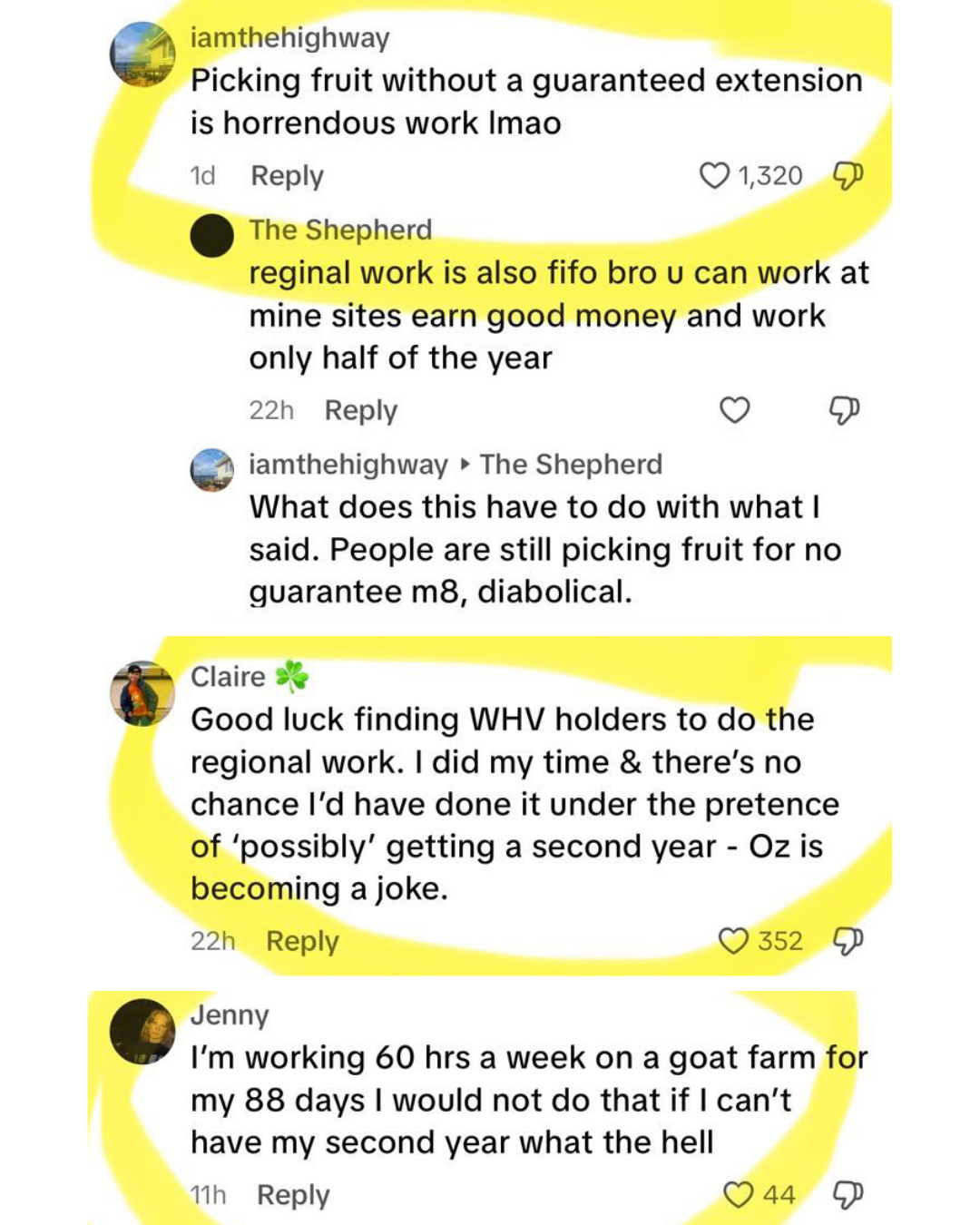
That phone call to our office was not an isolated reaction. Across Facebook groups and online communities dedicated to working holiday makers in Australia, backpackers responded to the announcement almost immediately. The dominant sentiment was not confusion. It was a decision.
Post after post across groups with tens of thousands of members said the same thing: if completing the 88 days, or 6 months, of regional work no longer guarantees a second-year visa, I am not going to do it. Why would I spend three months on a remote farm for a lottery ticket?
This Is Worse Than the Pause That Came Before
Before September 17, the government had quietly suspended WHM visa applications from 24 countries and slowed processing times across the board. The industry called it a crisis.
But the ballot is arguably worse. Here is why.
The pause stopped new people from entering Australia on WHM visas. But backpackers already in Australia on their first-year visa still had a reason to do the regional work. The second-year visa was still achievable if you put in the time.
The ballot changes the situation for people already in the country. It tells backpackers currently working their way through regional Australia: you can complete the regional work, but we might not give you a visa for it. The work requirement has not changed. The guarantee has gone.
Is This Exploitative? Let's Ask the Question.
The Working Holiday Maker program was designed for cultural exchange. Young people experience Australia. Australia gets seasonal labour. The deal was always implied: do the hard regional work, get the extra time in the country. That implied deal is now broken on the government's side.
We know the original system already had serious problems. The Fair Work Ombudsman's 2016 inquiry into the 417 visa program — which surveyed more than 4,000 overseas workers — found that 66% felt their employer was taking advantage of them. Some 35% believed they were paid less than minimum wage. Fourteen per cent had to pay in advance to get regional work. Six per cent had to pay an employer to sign off their 88 days.
The power imbalance between employers and backpackers chasing visa days was real, documented, and serious.
The ballot does not improve that dynamic. It makes it worse. A backpacker who has done their 88 days and is now waiting on a ballot result has even less leverage than before. They completed the requirement. They are not sure they will win the visa. An employer who knows a backpacker is desperate — and not certain they will win the ballot anyway — has even more power over them, not less.
Requiring the work while removing the reward is not a balanced system. It is one where the worker carries all the risk.
Was Anyone Actually Consulted?
At the National Press Club on September 17, Tony Burke presented the ballot as part of a measured plan to manage migration numbers. But how many backpackers were consulted before this was announced? How many received a phone call, a survey, or an invitation to comment?
The Tourism and Transport Forum told the Australian Financial Review that the industry had been "blindsided" by the changes. "All we would have liked was for government to consult us while they were thinking about this," TTF CEO Margy Osmond said.
The National Farmers' Federation also called for "urgent" consultation before any further changes — after the fact, not before. If peak industry bodies that depend on these workers were not consulted, it is reasonable to assume the workers themselves — the backpackers — were not either.
This was a policy decision made about them, not with them.
There Is a More Logical Approach
If the goal is to reduce the overall number of Working Holiday Makers in Australia, there is a simpler way to do it.
Reduce the number of first-year WHM visa grants. That controls total numbers at the point of entry. But leave the second and third year incentives intact. Keep the direct link between completing regional work and receiving the extension visa. Backpackers already in Australia still have a clear reason to do the regional work. Farms and hospitality businesses keep their workforce. And the deal remains honest: work the days, get the visa.
The ballot, by contrast, breaks the deal for people already here. It removes the motivation from workers already in the country and already willing to do the work. That is the wrong target and the wrong tool.
What Should You Do If You Are a Backpacker Right Now?
If you are currently in Australia on a first-year Subclass 417 or 462 visa, here is what to keep in mind.
- The ballot is not yet in place. No commencement date has been published. Rules made by ministerial direction can change.
- If you are already doing or planning your 88-day regional work, do not stop based on uncertainty alone. The situation is still evolving.
- Speak to an immigration lawyer before making decisions about your regional work or alternative visa pathways.
- There may be other visa options available depending on your nationality, skills, and situation.
- Do not assume the ballot is the end of the road. Get advice specific to your circumstances.
Can Work Visa Lawyers Help?
Yes. If you are a backpacker on a Subclass 417 or 462 visa and you are worried about what the ballot means for your plans, Work Visa Lawyers can help. Our team — including principal immigration lawyer Chris Johnston — understands this program in detail and is already hearing from backpackers affected by the uncertainty.
We can review your individual situation, explain your options, and help you find a path forward that makes sense for you. Contact us for an appointment.
Frequently Asked Questions
What is the backpacker ballot and when does it start?
The ballot is a new system for second and third-year Working Holiday Maker visas. Backpackers must still complete regional work, but they then enter a draw rather than automatically receiving a visa. Second-year places are capped at 45,000. Third-year places are capped at 5,000. No start date has been announced yet.
Do I still need to do 88 days of regional work if there is a ballot?
Yes. The 88-day requirement for a second-year visa still applies. The six-month requirement for a third-year visa still applies. The ballot does not remove those requirements — it just means completing them no longer guarantees a visa.
Does the ballot affect UK backpackers?
No. UK working holiday makers are excluded from the ballot under the Australia–UK Free Trade Agreement. They are also not required to complete regional work to extend their stay. This applies only to UK passport holders.
Why would I bother doing the regional work if the ballot means I might not get a visa?
That is exactly the question being asked by backpackers right now. The ballot removes the certainty that made the regional work worthwhile. Many backpackers will decide it is not worth the risk. That is the core flaw in this policy — it removes motivation for the very work requirement it still demands.
What happens if I do the regional work but don't win the ballot?
You will not receive a second or third-year visa through that pathway. Depending on your nationality, skills, and circumstances, you may have other options. A migration lawyer can advise you on what alternatives exist for your specific situation.
Is there any legal challenge to the ballot system?
The changes are being made by ministerial direction and regulation rather than legislation. That means they can be changed more quickly, in either direction. No legal challenge has been announced at this stage. Check the Department of Home Affairs website and speak to an immigration lawyer for the latest developments.
Disclaimer: This information is general only and does not take into account your personal situation. Australian migration rules and state nomination requirements can change quickly. You should get advice from a registered migration agent or immigration lawyer before making a visa decision.