Videos

4 Common Australian PR Mistakes That Can Ruin Your Chances in 2026

4 Common Australian PR Mistakes That Can Ruin Your Chances in 2026

4 Common Australian PR Mistakes That Can Ruin Your Chances in 2026

Many people come to Australia, study hard, work hard and follow the rules — but still miss out on permanent residency.

Sometimes the problem is not one big mistake. It is a small decision made early that quietly damages the whole PR pathway.

This article is about common mistakes that can hurt a person’s Australian permanent residency plans. The source script identifies four major traps: changing occupations too often, salary problems, weak work evidence and age-related timing issues.

These mistakes can affect skilled visas such as the 189 visa, 190 visa, 491 visa, 482 visa, 186 visa and 485 Graduate visa.

Mistake 1: Changing occupations too often

Some people keep changing their occupation because they are chasing the “easiest” PR pathway.

For example, a person may start with accounting, then move to cookery, then try engineering drafting, and later look at care work. This may feel like a smart move, but it can become a serious problem.

Many skilled visas require a suitable occupation, a skills assessment, relevant qualifications and/or relevant work experience. The Department of Home Affairs explains that skilled occupation lists include the occupations available for skilled visa programs and the relevant skills assessing authority for each occupation.

For the Skilled Nominated visa, subclass 190, Home Affairs says applicants must have an occupation on the relevant skilled list, have a suitable skills assessment and be invited to apply.

Why this can damage your PR pathway

Every time you change your occupation, you may “reset the clock”.

You may end up with:

  • not enough work experience in one occupation;
  • qualifications that do not match your nominated occupation;
  • difficulty passing a skills assessment;
  • fewer points for skilled migration;
  • no clear employer-sponsored pathway.

Better approach

Choose a realistic occupation early and build a strategy around it. This may include your course, job, skills assessment, English test, state nomination options and employer sponsorship options.

Mistake 2: Salary problems in employer-sponsored visas

This mistake often happens with employer-sponsored visas, including the Skills in Demand visa subclass 482 and the Employer Nomination Scheme subclass 186.

A person may receive a job offer, but the salary may not meet the legal or market salary requirements.

Home Affairs says that, for nomination applications lodged between 1 July 2025 and 30 June 2026, the Core Skills Income Threshold (CSIT) is AUD76,515. For the 2026–27 financial year, this is expected to increase to AUD79,499 from 1 July 2026, based on the annual indexation formula in the Migration Regulations and the latest ABS Average Weekly Ordinary Time Earnings data.

However, meeting the CSIT alone may not be enough. For employer-sponsored visas, the salary generally needs to meet the relevant income threshold and the Annual Market Salary Rate (AMSR) for the occupation. This means the employer must usually pay whichever amount is higher.

For example, if an engineer’s normal market salary is over AU$ 100,000, an employer may not be able to simply offer the minimum threshold and expect the visa pathway to be safe.

The salary must be checked carefully against:

  • the relevant skilled visa income threshold;
  • the annual market salary rate;
  • the role duties;
  • the occupation;
  • the employer’s business evidence.

Fair Work also notes that primary subclass 482 visa holders should be paid market salary rates by their sponsors.

Better approach

Before accepting an employer-sponsored pathway, check whether the salary is realistic for the occupation and industry. A low salary may look helpful to the employer, but it can create major visa risk for the applicant.

Mistake 3: Working as a “ghost employee” with no proper evidence

This can happen in hospitality, construction, trades, cleaning, care work and other industries.

A person may work long hours but receive cash payments with no payslips, no tax records and no clear bank evidence.

Cash payment itself is not always illegal. Fair Work says employees can be paid in cash, cheque or bank transfer. But employees must receive payslips, and employers must keep accurate pay and employment records.

Fair Work also explains that “cash in hand” payments where tax has not been taken out are against the law.

Why this can ruin your PR chances

For migration purposes, a letter from an employer may not be enough.

You may need strong evidence such as:

  • payslips;
  • bank statements;
  • tax records;
  • superannuation records;
  • employment contracts;
  • rosters;
  • invoices, if applicable;
  • position descriptions;
  • employer references.

Without proper evidence, your work may be hard to prove. This can affect:

  • your skills assessment;
  • points for Australian work experience;
  • employer-sponsored visa evidence;
  • your credibility with the Department.

For the Skills in Demand subclass 482 visa, Home Affairs states applicants must have the skills to perform the nominated occupation and 12 months of full-time work experience, or equivalent, in the occupation or a related field.

Better approach

Keep records from day one. Even if you are a student or casual worker, ask for payslips and make sure your pay, tax and super are recorded properly.

Mistake 4: Leaving your PR plan too late because of age limits

Age is one of the biggest timing risks in Australian migration.

Many people only start thinking seriously about PR when they are already close to the age limit.

For the Skilled Independent subclass 189 visa, Home Affairs says it will not process the visa application if the applicant is 45 at the time of invitation.

For the State Nominations l subclasses 190 visa and 491 visa, Home Affairs says applicants must be under 45 to be invited to apply.

For the Employer Nomination Scheme subclass 186 Temporary Residence Transition stream, Home Affairs says applicants usually must be under 45 years of age when they apply, unless an exemption applies.

The 43-year-old danger zone

If you are 43 or older, timing becomes very important.

For example, the subclass 186 visa usually requires eligible sponsored employment on a full-time basis for at least two years.

This means a person who wants to use a 482 to 186 pathway must think carefully about timing. Waiting too long may mean the person turns 45 before they are ready to apply.

Graduate visa age trap

The Temporary Graduate visa subclass 485 also has age limits.

For the Post-Higher Education Work stream, Home Affairs says applicants must be 35 years or under when they apply.

This can be a serious issue for students who start a course in their mid-30s and only realise later that they may be too old for the Graduate visa when they finish.

Better approach

Do not wait until the last year of your visa. Check your age, course, occupation, English, skills assessment and sponsorship options early.

How to protect your Australian PR pathway

Here are practical steps that may help:

  1. Choose a realistic occupation early
    Do not change careers only because you heard one occupation is “easy” for PR.
  2. Check your skills assessment requirements
    Each occupation may have different requirements.
  3. Keep strong work evidence
    Payslips, tax records and super records can be very important.
  4. Check salary before relying on employer sponsorship
    The salary should meet the relevant income threshold and the market salary rate.
  5. Plan before age becomes a problem
    If you are close to 35, 43 or 45, get advice early.
  6. Get professional advice before making major decisions
    A wrong course, wrong occupation or wrong job can cost years.

Frequently asked questions

Can changing my course affect my PR chances?

Yes. Changing your course might affect your PR pathway if it changes your occupation, skills assessment options or Graduate visa strategy. Before changing course, check whether the new course connects to a real skilled migration or employer-sponsored pathway.

Is cash work useful for Australian PR?

Cash work may be difficult to use for migration purposes if there are no proper records. Fair Work says cash payment can be acceptable if tax is withheld and super is generally paid, but “cash in hand” arrangements where tax is not taken out are against the law.

Is the minimum salary enough for a 482 visa?

Not always. The salary must meet the relevant skilled visa income threshold and the annual market salary rate, whichever is higher.

Can I apply for PR after 45?

Some pathways may still exist after 45, such as certain labour agreement pathways, DAMA arrangements or family visas, depending on your circumstances. However, many skilled visas become much harder or unavailable after 45.

When should I start planning for Australian PR?

You should start as early as possible, ideally before choosing a course, occupation or employer-sponsored pathway. PR planning is not just about the final visa application. It often starts years earlier.


Final thoughts

Australian permanent residency is not only about working hard. It is about working hard in the right direction.

The four mistakes that can damage your PR chances are:

  • changing occupations too often;
  • accepting a salary that does not meet visa requirements;
  • working without proper evidence;
  • waiting too long and missing age limits.

If you are unsure about your PR pathway, book a consultation with Work Visa Lawyers. A clear strategy may help you avoid costly mistakes and choose a pathway that matches your real situation.

Book an Appointment

Continue reading
0 Comments

How to Get Australian PR in 2 Years - The 482 to 186 Visa Pathway

How to Get Australian PR in 2 Years - The 482 to 186 Visa Pathway

How to Get Australian PR in 2 Years - The 482 to 186 Visa Pathway

Getting Australian Permanent Residency (PR) can feel like a long, tiring journey. Many migrants spend years chasing points-based visas, doing skills assessments, and taking English tests over and over, only to wait for an invitation that may never come.

But there is a simpler, more direct way: employer sponsorship.

If you have a supportive employer willing to sponsor you, the pathway from a Subclass 482 Visa to a Subclass 186 Permanent Resident Visa is one of the best options in Australia right now.

Why the 482 to 186 Pathway is a Game Changer

  • No points test required.
  • No state nomination needed.
  • No waiting for unpredictable invitation rounds.
  • Clear timeline: Work for 2 years on a 482 visa for your sponsor, then apply for PR 186 TRT visa.

Here is a simple, easy-to-understand guide on how this powerful visa pathway works.

Step 1: What is the 482 Visa?

The Subclass 482 visa allows Australian businesses to sponsor skilled overseas workers when they cannot find local staff.

Important Name Change: In December 2024, the Australian Government renamed the Temporary Skill Shortage (TSS) visa to the Skills in Demand (SID) visa. However, it is still officially the Subclass 482 visa. Whether people call it the 482 visa, the SID visa, or the old TSS visa, they mean the same thing.

If your 482 visa is approved, you can:

  • Work full-time in Australia for up to 4 years.
  • Bring your eligible family members with you.
  • Travel in and out of Australia.
  • Be paid a fair Australian salary.

How do I get the 482 Visa?

To apply for the new 482 Skills in Demand visa, you generally need to meet these main rules:

  1. Approved Sponsor: You must have an Australian employer who is approved to sponsor you.
  2. Occupation List: Your job must be on the Core Skills Occupation List (456 occupations available) or qualify under the Specialist Skills stream for high earners.
  3. Work Experience: You only need 1 year of relevant full-time work experience (the government recently reduced this from 2 years!) if you meet the skill requirements.
  4. English Score: You need an IELTS score of 5.0 (or equivalent).
  5. Minimum Salary: Your employer must pay you at least the Core Skills Income Threshold (currently $76,515, rising to $79,499 from 1 July 2026) AND match the local market salary rate.

(Note: Most occupations do not require a formal skills assessment for this visa, though some occupations do).

Step 2: Transitioning to 186 Permanent Residency

The 482 visa is your bridge to staying in Australia permanently. You can do this through the 186 Temporary Residence Transition (TRT) stream.

However, PR is not automatic. Your employer must agree to nominate you for the permanent 186 visa.

What are the rules for the 186 TRT Visa?

To move from your 482 visa to 186 PR, you must meet these requirements:

  • Work for 2 Years: You must hold your 482 visa and work in your sponsored job for at least 2 years. (Great news: Under new rules, if you change employers, your time does not reset. You can combine time worked across multiple approved sponsors!)
  • Employer Nomination: Your employer must nominate you for the permanent visa.
  • Age Limit: You must be under 45 years old when you apply (unless you qualify for a special exemption).
  • English Score: You need to improve your English to a Competent English level, which is an IELTS score of 6.0 (or equivalent) in all bands.
  • No New Skills Assessment: You generally do not need a formal skills assessment for the TRT stream stage.

How to Find a Sponsoring Employer

We know that asking an employer for sponsorship can feel scary. Finding a business willing to sponsor you can also be challenging. However, many Australian employers are very happy to sponsor good workers because it gives them loyal, skilled staff.

Work Visa Lawyers do not help individuals find jobs or match them with sponsors. However, we know this is the hardest step. If you need help finding a business, please watch our YouTube video titled "How to Find a Sponsor" for practical, real-world tips.

Need Advice from the Best Immigration Law Firm in Australia?

Immigration rules can change, and everybody's situation is a little bit different. A small mistake in your timeline or your salary rate can delay your PR.

If you have found an employer, or if you want to know if you qualify for the 482 to 186 pathway, you want to ensure your application is handled perfectly. Recognised as the best immigration law firm in Australia, our expert team at Work Visa Lawyers has the knowledge and proven track record to guide you through these complex processes.

You can book an appointment to talk to our expert immigration lawyers today. Let our experienced team and the best in the business help you plan a safe, clear, and successful pathway to your Australian Permanent Residency.

Book an Appointment

Continue reading
0 Comments

February Immigration News 2026: An Anti-Immigration Party Is Rising, State Nomination Updates and the Best Australian Visas for 2026

February Immigration News 2026: An Anti-Immigration Party Is Rising, State Nomination Updates and the Best Australian Visas for 2026

February Immigration News 2026: An Anti-Immigration Party Is Rising, State Nomination Updates and the Best Australian Visas for 2026

In this February immigration update, we focus on the information that will help you plan and apply for Australian permanent residency (PR) in 2026.

This month’s key topics include:

Watch the Full Video:

Political Shift: The Rise of One Nation and Immigration Policy

One Nation is now recording its second-highest approval rating. This is a major political shift that could ultimately lead to a reduction in immigration. This may negatively impact the chances of many people seeking Australian permanent residency.

The Rise of One Nation

To quote the Australian Financial Review on 1 February:

“Following two weeks of Coalition infighting, first-preference support for One Nation has jumped to 26 per cent, up from 17 per cent in December. One Nation overtaking the Liberals and Nationals for the first time ….”

In the same poll, Labor was at 34 per cent.

What are the current immigration policies of One Nation?

According to their website, One Nation’s migration policies include:

  • Capping visas at 130,000 per year — referring to permanent residency visas, which are currently set at 185,000 per year
  • Deporting 75,000 illegal migrants
  • Reintroducing Temporary Protection Visas (TPVs)
  • Proposing an eight-year waiting period for citizenship and welfare eligibility

The history of One Nation began with an anti-immigration maiden speech by Pauline Hanson in 1996. There have been many ups and downs since then.

In her maiden speech, she called for multiculturalism to be abolished, with anti-multiculturalism themes continuing to the present.

One Nation is generally anti-immigration, and if it gains more popularity, this could reduce immigration in the future.

For example, major parties could adopt or move closer to One Nation policies. This previously occurred during the John Howard period.

State Nomination News: 190 and 491 Visa Updates

New South Wales 491 Visa Closed

On 19 January 2026, New South Wales opened and closed its 491 Pathway 1 and Pathway 3 on the same day due to exceptionally high demand. Many people missed out simply because they couldn’t apply quickly enough.

Is NSW selecting the best candidates or just the fastest applicants?

South Australia Invitation Rounds

South Australia is currently running invitation rounds on the first Monday of each month.

For February, South Australia invited:

Health professionals were the clear winners in this round.

If you are working in healthcare or an allied health occupation, South Australia may currently offer stronger prospects than some other states.

Northern Territory Closure

The Northern Territory has now closed to new applications.

According to the NT Government website:

“The NT Government has now received sufficient applications to fill the nomination allocation for the 2025–26 program year. The NT nomination portal is now closed to new applications. Applications lodged prior to the closure will continue to be assessed, with outcomes to be provided by 30 June 2026.”

We expect more states to start closing soon.

Should You Move States for State Nomination?

This is one of the most common questions we receive.

Work Visa Lawyers is cautious with this advice because every state is dealing with the same issue: large numbers of temporary visa holders competing for a relatively small number of state nomination places.

We are now well into the 2025–26 program year, which ends on 30 June 2026.

There is a real risk that you:

  • Relocate
  • Spend significant money
  • Change jobs
  • And then the state program closes shortly after

Relocating is expensive, and finding new employment takes time. Migration decisions should be strategic — not reactive.

Please book an appointment before you move states. 

Employer-Sponsored Visas: 482 and 186 Pathways

This brings us to employer-sponsored visas, such as:

If you secure a genuine job offer with strong prospects of sponsorship in your occupation, I am much more open to relocation.

At the moment, employer-sponsored visas can be a more reliable pathway than waiting for state nomination invitations.

Of course, finding an employer willing to sponsor you is not easy. We have published guidance on how to approach employers strategically and position yourself for sponsorship.

DAMAs: A Growing Alternative Pathway

We are seeing increasing interest in Designated Area Migration Agreements (DAMAs).

DAMAs are employer-sponsored migration pathways designed for specific regional areas.

Traditionally, interest was driven by:

  • A broader range of eligible occupations
  • Access for truck drivers, disability carers, and other critical roles
  • Age concessions (particularly for applicants aged 45–55)

Increasingly, however, we are seeing applicants turn to DAMAs after years of trying — and failing — to receive invitations for the Subclass 189, 190, or 491 visas.

This is especially common for onshore applicants who are not receiving invitations and need a more realistic pathway to Australian PR.

National Innovation Visa: Queensland Focus

We are seeing strong interest in Queensland’s state nomination options under the National Innovation Visa framework.

Queensland currently offers:

  • An entrepreneuroptionrequiring a $1 million investment
  • An investoroptionrequiring a $5 million investment

Entrepreneurs and investors often do not fit neatly into traditional migration models. Their education may not align with their professional history, they may not suit skills assessments, and they are typically not dependent on a single employer.

The flexibility of the National Innovation Visa is what makes it so attractive.

We offer a free assessment for those wishing to explore whether this pathway could suit their circumstances.

New Income Threshold for Employer-Sponsored Visas

The new income threshold for the upcoming financial year, starting on 1 July, will be announced soon.

If the government applies a similar increase to last year (approximately 4.6%) the minimum salary requirement for employer-sponsored visas such as the Subclass 482 and Subclass 186 could rise from $76,515 to approximately $80,000.

The Australian Bureau of Statistics will publish its latest Average Weekly Earnings report on 26 February, which will provide a clearer indication of the likely increase.

If you are close to the current threshold, timing may become critical.

Hate Speech Laws and Migration Policy

Hate speech law changes have now been enacted, and we will continue to monitor how these affect migration policy, visa decision-making, and visa cancellation powers.

Planning Your Australian PR Strategy in 2026

The Australian migration landscape is becoming increasingly competitive and politically sensitive. With tighter state nomination programs, rising income thresholds and potential political shifts influencing migration caps, applicants must approach their Australian permanent residency strategy with careful planning and informed decision-making.

Key takeaways for 2026 include:

  • DAMAs are becoming a realistic and structured regional alternative
  • Income thresholds for sponsored visas are likely to rise
  • Political developments could influence future migration caps and policy settings

In this environment, relying on timing or chance is no longer sufficient. A clear, strategic migration plan — tailored to your occupation, visa history and long-term goals — is more important than ever.

Work Visa Lawyers is recognised as one of Australian’s leading immigration law firms, with extensive experience in skilled migration, employer-sponsored visas, DAMAs, partner visas, global talent, national innovation visa and complex migration matters. 

Our team of immigration lawyers and registered migration agents provides strategic advice through both in-person consultations in Adelaide and secure online consultations for clients across Australia and overseas.

If you are planning your Australian PR pathway in 2026, obtaining professional guidance early can significantly improve your prospects and reduce unnecessary risk.

Talk to an Immigration Lawyer

Continue reading
0 Comments

Australian Immigration News 2026: Real Visa Pathways to Permanent Residency and Visa Updates  

Many people planning their future in Australia are asking the same question:

Will I ever get permanent residency in Australia? 

If you are studying, working, or living in Australia on a temporary visa, you may be wondering whether permanent residency is still realistic in 2026 — or whether the system has moved out of reach.

This article looks at the real migration opportunities for 2026, using current data and practical strategies. We also address difficult but important topics, including:

  • Visa cancellations and stricter checks
  • How major events, such as the Bondi Beach attack, may influence immigration processing

Our goal is to help you make smarter, more realistic decisions about your migration pathway.

How the Recent Bondi Beach Attack Is Affecting Australian Immigration Processing

We would like to begin by expressing our sincere condolences to the victims and families affected by the tragic Bondi Beach attack in December.

For people living in Australia on temporary visas, this event may have broader implications. We expect to see:

  • Stricter background and character checks
  • Increased visa cancellations
  • Greater scrutiny across visa applications

We will address this topic in more detail in a separate article, as it deserves careful and sensitive discussion.

Are 189, 190 and 491 Visas Still Realistic in 2026?

The reduction in places for the 190 and 491 visas has caused many people to ask whether Australia is still achievable.

The answer is yes — for some people. However, the strategy has changed.

For many years, points-tested visas such as the 189 visa, 190 visa, and 491 visa were the primary goal for skilled migrants, with employer sponsorship seen as a second option. That is no longer the case.

Employer-Sponsored Visas: The Strongest Pathway in 2026

If your goal is Australian permanent residency, employer-sponsored visas are now the strongest and most realistic options in 2026.

These include:

Australian businesses are facing genuine skills shortages across multiple sectors and are actively seeking reliable workers. As a result, we have seen:

  • A significant increase in employer-sponsored visas
  • A sharp reduction in state nomination places, including the 190 visa and 491 visa

Visas such as the 482 visa provide a pathway from temporary work to permanent residency through the 186 visa and many migrants are using this pathway as the first option.

Book an Appointment

Why State Nomination Is More Competitive Than Ever

Many people ask whether they should target states like Western Australia or Tasmania, which often appear to have more flexible criteria.

However, the reality is this:

  • Tasmania has 1,850 nomination places in 2025-26 financial year
  • Western Australia has 3,400 places — with 3,355 already issued 
  • Combined, that is only 5,250 nominations

You are not competing against hundreds of applicants — you are competing against hundreds of thousands of skilled migrants who already have:

  • Skills assessments
  • English test results
  • Work experience
  • Active EOIs

Most applicants, no matter how qualified, will never receive an invitation.

This does not mean the General Skills Migration (GSM) program is dead — but it is highly competitive. 

Which Occupations Are Still Receiving Invitations?

Looking at invitation results from 2025, one thing is clear: Australia is inviting only where there is genuine demand.

If you are under 45 and your occupation is clearly in shortage, it may still be worth:

  • Obtaining a skills assessment
  • Improving your English score
  • Positioning your EOI strategically

High-Demand Jobs in Australia for Skilled Migration

Occupations currently receiving invitations include:

  • Construction trades (bricklayers, carpenters, electricians, plumbers, roofers)
  • Construction managers
  • Healthcare professionals
  • Secondary school teachers

When GSM Is Not the Best Migration Pathway

Some occupations remain on the skilled lists but are not receiving invitations, including:

  • Marketing specialists
  • Accountants
  • Cooks
  • Enrolled nurses
  • Software engineers
  • Contract administrators
  • Niche roles such as artistic directors, copywriters, and dog handlers

In these cases, GSM visas may not be your strongest pathway.

Alternative Visa Options to Consider

Instead, you should consider:

  • Alternative pathways, such as partner visas if you have an Australian Citizen or Permanent Resident partner

We understand that employer sponsorship is not easy — especially if you are offshore — but thousands of applicants succeed each year, and you may be one of them.

Check our blog, “How to Find a Sponsor,” for helpful tips on how to find an Australian business to sponsor you.

Australia Visa 2026

Queensland National Innovation Visa (Subclass 858) – 2026 Update

Queensland has now opened nominations for the National Innovation Visa (Subclass 858).

This visa offers direct permanent residency and targets exceptionally talented individuals, including:

  • Entrepreneurs
  • Innovative investors
  • Researchers
  • Athletes
  • Creatives

Permanent Residency Pathway for Individuals: 

• Up to the age of 55, or higher in exceptional cases 
• High-value entrepreneurs who commit AUD $1 million to new ventures in Queensland 
• Innovative investors who invest AUD $5 million in Queensland’s innovation ecosystem

This is one of the strongest permanent residency pathways currently available.

 
We have published a detailed guide explaining the Queensland NIV nomination process.

 
We also offer a free NIV assessment, where our team can check your eligibility.

Adelaide University Opens: What This Means for Students

Following the merger of the University of Adelaide and the University of South Australia, Adelaide University has officially opened enrolments, becoming the largest university in Australia.

This will bring:

  • More international students
  • Increased investment in South Australia

However, students must have a clear migration strategy before enrolling and applying for a student visa, especially if permanent residency is part of the long-term plan.

Check our blog “Best 8 courses to study in Australia to get PR”. 

Student Visa Changes for India, Nepal, Sri Lanka, Bangladesh and Bhutan

Applicants from India, Nepal, Sri Lanka, Bangladesh, and Bhutan may face increased scrutiny, as Australia has updated student visa assessment levels to strengthen integrity measures.

These changes may have been triggered by reports of widespread fraudulent degree practices. As a result, it is more important than ever for students to submit strong, well-documented applications.

Student Visa Expiry Reminder: Avoid Becoming Unlawful

We are seeing a large number of student visas expiring in March, many around the 15th.

Every year, people make the same mistake — waiting too long.

If your visa is expiring soon:

  • Do not wait until the last minute
  • Understand your next visa options early
  • Lodge a valid application before expiry

Options may include course extensions, graduate visas, or transitions to skilled visas — but timing is critical.

How We Can Help You Plan Your Migration Strategy for Australia in 2026 

Migration to Australia in 2026 is still possible — but it requires realistic expectations, the right strategy, and early planning.

At Work Visa Lawyers, we are widely regarded as one of the best migration lawyers and one of the best registered migration agents in Adelaide, with extensive experience across skilled, employer-sponsored, and permanent residency pathways.

If you would like tailored advice based on your individual circumstances, please book an appointment and talk to our team.

Book an Appointment


Continue reading
0 Comments

Australian Immigration News – Latest updates

Australian Immigration News – Latest updates

Major visa cuts, backlogs, and new opportunities revealed at the MIA National Migration Conference

Big changes have just been announced in Australian immigration — including potentially visa quota reductions and major updates straight from the Migration Institute of Australia’s National Migration Conference in Melbourne.

Are your migration plans about to change? Let’s take a closer look at what’s happening.

Migration Quotas and State Nomination – Up to a 30% Cut

The Federal Government has confirmed a total of 185,000 permanent migration places for the 2025–2026 financial year — the same overall number as last year.

However, there’s growing concern that state and territory allocations will be significantly smaller, as the Department of Home Affairs (DHA) continues to face backlogs from unprocessed visa applications.

For example, Western Australia’s Premier Roger Cook is fighting to prevent a reduction from 5,000 to 3,400 skilled migration places. He has formally written to the Federal Government, urging them to reconsider the cuts.

If WA faces a 30% reduction, similar cuts may occur across other states — except for Queensland, which is expected to see an increase after receiving a very small allocation of only 1,200 places last year.

At this stage, only small interim allocations have been released, allowing states to issue a limited number of invitations for Subclass 190 and Subclass 491 visas.

Many states have already published their eligibility criteria for this financial year, and some are already open for Expressions of Interest (EOIs).

A detailed update on each state’s 190 and 491 requirements will be published separately soon.

Deportations and Visa Cancellations

According to several news articles, Home Affairs Minister Tony Burke confirmed that the first transfer to Nauru under a new agreement has taken place, triggering an upfront payment of AUD 408 million. The deal — expected to cost around AUD 2.5 billion — has faced criticism from human rights groups.

Additionally, the government has made headlines by denying entry to certain individuals, including Dutch athlete Steven van de Velde, a convicted child sex offender, under section 501 visa cancellation powers.

Key Takeaways from the MIA National Migration Conference 2025

In early October, the Migration Institute of Australia’s National Migration Conference was held in Melbourne. Chris Johnston from Work Visa Lawyers attended the event alongside our lawyer Shamsiya Mohammadi, gathering valuable insights about the government’s direction in migration policy.

10

Visa Processing and Backlogs

According to Damien Kilner from the Department of Home Affairs, the backlog of pending visa applications remains a serious challenge.

As of October 2025, there are:

  • 58,000 pending Subclass 186 Employer-Sponsored Visa applications, compared to an annual target of 44,000 places.
  • 98,000 pending Partner Visa applications, with an annual target of 40,500.

This means that the partner visa backlog is growing by approximately 25,000 applications per year, and without major reform, waiting times could extend to five years or more.

DAMA Update – More Regional Flexibility Ahead

The Department of Home Affairs confirmed that it favours full-state DAMA agreements rather than fragmented regional ones.

This suggests that:

  • Tasmania may soon receive its own state-wide DAMA.
  • Queensland, New South Wales, and Victoria could move toward full-state DAMAs, replacing the current patchwork approach with more consistent coverage.

This would provide greater flexibility for employers in regional areas to sponsor overseas workers under the Designated Area Migration Agreement (DAMA) program.

Political Debate: Labour vs. Liberal on Migration Policy

The conference also featured a lively political debate between Labour and Liberal representatives.

Julian Hill MP, Assistant Minister for Citizenship and Multicultural Affairs, spoke about rebuilding a coherent migration system after years of inconsistent policies and underinvestment.

Hill confirmed that net overseas migration has fallen by more than 40%, returning to pre-COVID levels, and emphasised the economic importance of international students, who support over 250,000 Australian jobs.

He stated:

“Australia is not facing mass migration — our borders remain tightly controlled.”

Hill also criticised the opposition, saying the Liberals were:

“Both terrified of yet cuddling up to One Nation, calling for ‘massive cuts’ to migration, but never saying how or where that should occur.”

In response, Liberal Senator Paul Scarr, Shadow Minister for Immigration, took a more measured stance.

He argued that:

“Our immigration policy must be in our national interest. But, more than that, the debate in relation to immigration policy must be conducted in a way which is also in our national interest — it must not seek to inflame emotion.”

Scarr called for:

  • Greater transparency in the migration program.
  • A return to multi-year migration planning (which has not been reintroduced).
  • Faster processing times for the new Skills in Demand (SID) 482 visa, which are currently exceeding expectations.

While both sides of politics offered valid points, the ongoing lack of certainty and predictability continues to affect Australian businesses and regional employers struggling with skill shortages — as well as visa applicants themselves seeking confidence in the system.

11

Where Are the Opportunities for Applicants?

Despite the cuts and backlogs, there are still strong opportunities in key sectors.

Under Ministerial Direction 105, healthcare professionals and teachers are being prioritised for skilled visa processing. 

The federal and state governments are also prioritising construction workers and tradespeople due to the housing crisis. 

For those outside these priority sectors, employer sponsorship or partner visas may be the most practical migration pathways.

Check out our blog “How to find a sponsor”. 

Rising Interest from U.S. Citizens

There has been a noticeable increase in protection visa applications from U.S. citizens between August 2024 and July 2025, according to Department of Home Affairs data.

Work Visa Lawyers has also assisted many U.S. citizens applying for partner visas, reflecting a growing interest in migration pathways to Australia from the United States.

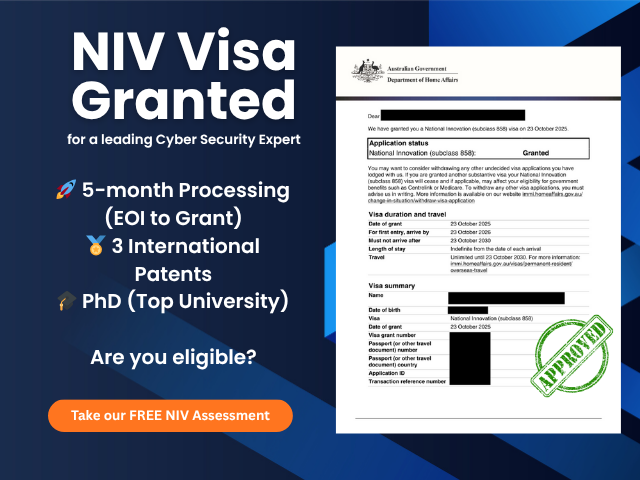
National Innovation Visa Granted – Critical Technology 

The new National Innovation Visa (NIV) continues to show promising results.

In October, Work Visa Lawyers successfully obtained a National Innovation Visa grant for a client working in critical technologies (cyber security).

The processing time was impressively fast, the visa was lodged in August and granted in October, taking just two months.

If you are a global talent or entrepreneur working in high-tech or innovation sectors, you may be eligible for this visa.

You can check your eligibility with our Free NIV Assessment on the Work Visa Lawyers website.

12

What to Expect Next? 

Australia’s migration landscape is shifting rapidly, with significant cuts to state allocations, extended processing delays, and increasing political debate about migration levels.

While there is uncertainty, opportunities remain strong in healthcare, education, construction, and technology sectors.

At Work Visa Lawyers, we continue to monitor all official updates from the Department of Home Affairs and state and territory governments.

Follow us on Instagram, TikTok, Facebook or YouTube for short updates. 

Applying for an Australian Visa

If you want to discuss your specific situation or visa options, please book an appointment with one of our lawyers.

Our experienced team of immigration lawyers and registered migration agents can guide you through your best options.

Contact Work Visa Lawyers today to book a consultation and get personalised advice for your visa pathway.

Book an Appointment

Continue reading
0 Comments

Sign up to our Migration Newsletter

Work Visa Lawyers works on Kaurna Land
We acknowledge and pay respect to the past, present and future Traditional Custodians and
Elders of this land and this nation, and the continuation of cultural, spiritual and educational
practices of Aboriginal and Torres Strait Islander peoples.

This site's contents are for general information purposes only
We recommend you seek advice from a Registered Migration Agent and Lawyer
(such as Work Visa Lawyers) in relation to your factual situation and relevant migration laws

Liability limited by a scheme approved under Professional Standards Legislation

Site by Adelaide Websites