

Do you plan to visit Australia on a visitor visa and then apply for a work visa? Your visa may carry condition 8503 (No Further Stay). This condition can stop you from applying for another visa while you are in Australia.
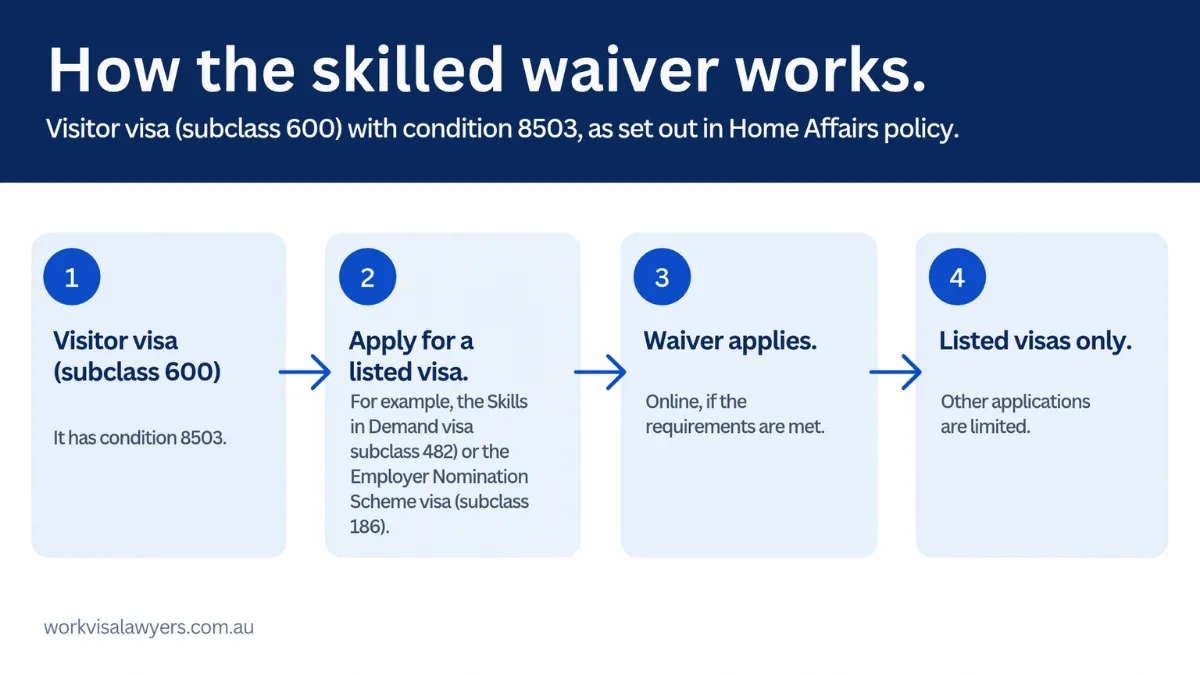
There is a skilled waiver for some people, often called an 8503 waiver. A waiver means the condition does not stop you. It can apply if you have a “genuine intention” to apply for certain visas. These include the Skills in Demand visa (subclass 482) and the Employer Nomination Scheme visa (subclass 186). The waiver is limited to the visas on the policy list.
The short version: 8503 waiver for 482 and 186 visas
- Condition 8503 is a “No Further Stay” condition. It can stop you from applying for another visa while you are in Australia.
- A skilled waiver can apply if you have a “genuine intention” to apply for a listed visa, such as a 482 or 186 visa.
- Home Affairs policy says skilled applicants do not need to send a waiver request.
- The waiver is limited. After it applies, you can only make a valid application for the visas on the policy list.
- A visitor visa is for genuine visits. Get professional advice before you plan to change visa in Australia.
Who this 8503 waiver guide is for
This guide is for:
- people planning to visit Australia who may later want a work visa
- people already in Australia on a visitor visa only
- family members who may be affected by the same rules
- employers who want to understand how this affects a worker on a visitor visa
This is general information. It is not advice about your own case.
What is condition 8503 (No Further Stay)?
Condition 8503 is a visa condition called “No Further Stay”. Home Affairs policy also calls it a “no further application” condition.
To check if your visa has it, look at your visa grant letter, Visa Entitlement Verification Online (VEVO) or the myVEVO app.
There are other ways to ask for a waiver. This article covers only the skilled waiver. For other cases, read our guide to condition 8503.
What is the 8503 waiver for skilled visas?
Home Affairs policy says condition 8503 can be waived if you have a “genuine intention” to apply for a listed visa. These are the visas on the list.
Skills in Demand visa (subclass 482)
The policy lists the subclass 482 visa. It uses the older name, Temporary Skill Shortage. The visa is now called the Skills in Demand visa.
The 482 is not a SkillSelect visa. SkillSelect is the Australian Government’s online system for skilled migration.
Employer Nomination Scheme visa (subclass 186)
The policy lists the subclass 186 visa. The 186 is a SkillSelect visa. It is one of two SkillSelect visas that do not need an invitation to apply.
Other visas on the 8503 waiver list
The policy also lists these visas:
- a General Skilled Migration visa. The policy says this means one of these subclasses, granted at any time: 175, 176, 189, 190, 475, 476, 485, 487, 489, 491, 885, 886 or 887
- a Business Talent visa (subclass 132). It is closed to new applicants, but active applications and waivers are being considered
- a Regional Sponsored Migration Scheme visa (subclass 187)
- a Business Innovation and Investment (Provisional) visa (subclass 188)
- a Permanent Residence (Skilled Regional) visa (subclass 191)
- a Skilled Employer Sponsored Regional (Provisional) visa (subclass 494)
Do you need to ask for the waiver?
No. Home Affairs policy says skilled applicants do not need to make a waiver request. The policy says that applying for one of the listed visas is considered enough for the waiver.
For online applications, the Department’s system can do this for you. The policy says ImmiAccount waives condition 8503 automatically when you apply through SkillSelect, if the requirements are met. ImmiAccount is the Department’s online lodgement system. There is no “do not waive” option.
The 482 is not a SkillSelect visa. The policy says the Department’s lodgement systems also support an automatic waiver for the 482 and the 494.
The policy also says this applies when a dependent family member applies for one of the listed visas. The rules for family members are complex. Get professional help before you apply.
What the skilled waiver does not allow
The waiver is limited. Read these points with care.
- Only listed visas. After the waiver, you can only make a valid application for a General Skilled Migration visa or one of these subclasses: 132, 186, 187, 188, 482 or 494.
- Example. A person applies for a 482 visa and the condition is waived. That person cannot then apply for a different visa, such as a Partner visa, on the basis of the skilled waiver under regulation 2.05(4AA). The Partner visa is an illustration only.
- A 482 that is not yet decided. The policy gives the example that you may apply for a subclass 187 visa without waiting for the 482 visa to be granted, but this could include the 186 or other listed visas.
- Invitations. If a visa needs an invitation to apply, you must have one. It must be issued within 60 days before you apply. If it is older, you cannot make a valid application on it, and the waiver does not apply.
- Application bars. Some people have an application bar, such as a section 48 bar. The policy says you must still be outside Australia to apply for a SkillSelect visa if you were invited to apply.
- Other conditions. Conditions 8535 and 8540 are not covered by these waiver rules.
Is condition 8503 now on visitor visas?
On 17 September 2026, the Government announced a No Further Stay condition for all visitor visas. It said the aim is that visitor visas are only used by genuine visitors, and not as a pathway to extending a stay in Australia.
Home Affairs says the changes have begun and will be rolled out over the next 12 months. The Department is now applying condition 8503 to most visitor visas. Check your own visa conditions. Read our overview of the September 2026 migration reforms for more.
Know the limits of your visitor visa
A visitor visa is for genuine visits. Your visa has its own conditions and limits. These may limit what you can do in Australia.
If you are not sure what your visa allows, or what your plans mean for your visa, get professional help. Do this before you travel or apply. These rules are complex, and a mistake may limit your options later.
What to do next
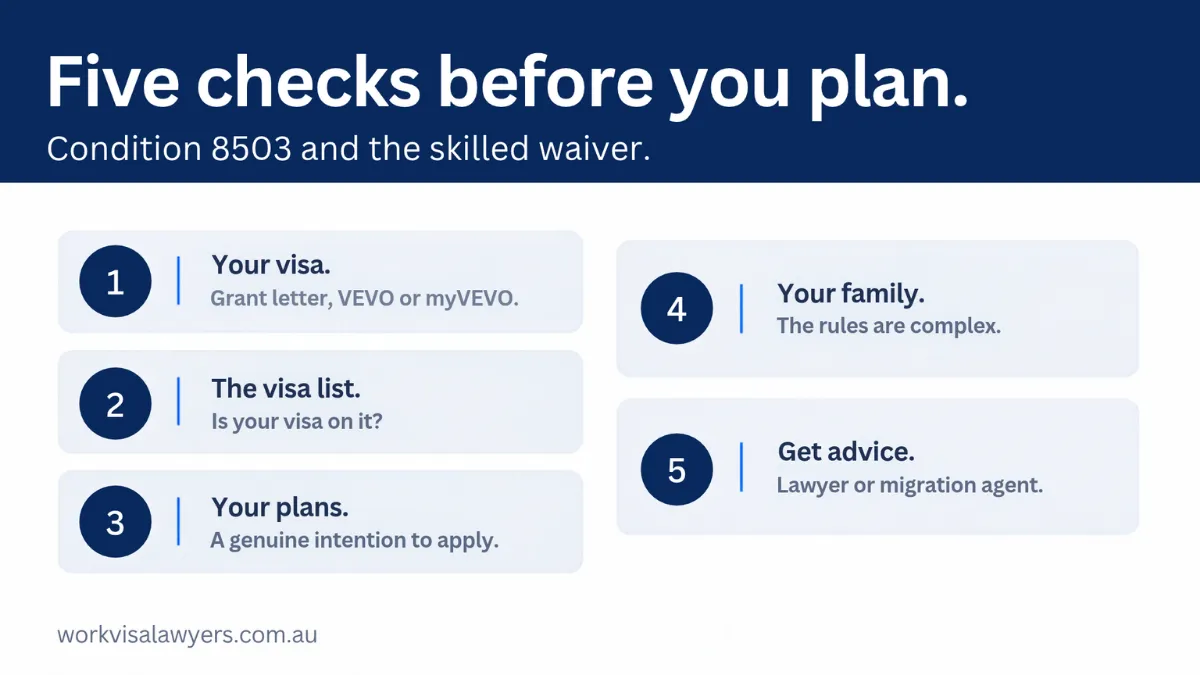
- Check your visa conditions in your grant letter, VEVO or the myVEVO app.
- Check if the visa you want is on the policy list.
- Think about whether you have a genuine intention to apply for that visa.
- Think about your family members. The rules for them are complex.
- Speak to an immigration lawyer or registered migration agent before you act.
Get advice before you apply
The rules for condition 8503 and the skilled waiver are complex, and every situation is different. Work Visa Lawyers can check your situation, explain your options and help prepare your application, through our immigration lawyers and registered migration agents. Book an appointment or speak to our team before you plan your next step.
Talk to an Immigration LawyerKeep reading
- No Further Stay condition (8503): how to extend a visitor visa: read about the general waiver and extending a visitor visa.
- How to find a sponsor: useful if you need an employer to sponsor you.
- The 482 to 186 pathway: learn about both visas together.
Official sources
- Home Affairs policy: About Skilled waivers
- Minister for Home Affairs media release, 17 September 2026
- Home Affairs: Australian Government Migration Policy Changes
- Home Affairs: No Further Stay waiver request form
Disclaimer: This information is general only and does not take into account your personal situation. Australian employer sponsorship rules, salary thresholds and sponsor obligations can change quickly. You should get advice from a registered migration agent or immigration lawyer before sponsoring a worker or making a visa decision.