
Employers can pay up to $7,200 to sponsor a skilled worker. If the nomination is refused, most of them do not get a cent back — and they still have no worker.
Employers paid $499.8 million through the Skilling Australians Fund (SAF) levy in 2024–25. That is up 51% in two years.
The Skilling Australians Fund has three big problems. They are punishing employers and making it harder to fill shortages in critical services. Each problem has a fix.
Problem 1: You pay up to four years upfront
The fix: let employers pay monthly, or later, instead of all at once.
A small business pays $4,800 to sponsor a worker on a four-year visa. A larger business pays $7,200*.*
You pay the full amount when you lodge the nomination, before you know whether it will succeed.
The Government’s own Migration Strategy says upfront payment deters new employers from sponsoring workers*.*
The 2023 Review of the Migration System proposed monthly instalments instead. Members of the Ministerial Advisory Council on Skilled Migration (MACSM) suggested charging the levy only when the visa is granted or the worker starts. The Government said in 2023 it would explore monthly or quarterly charges*.*
Problem 2: You can lose it all if the nomination is refused
The fix: refund the levy when a nomination or visa is refused, unless there is fraud.
The grounds for a refund are very narrow. You can ask for one if Home Affairs made a mistake, or if you withdraw before a decision because the levy information was wrong. You can also ask if your sponsor application fails first, the visa is refused on health or character grounds, or the worker never starts. A partial refund applies for temporary visas if the worker leaves within 12 months.
A refused nomination is not on that list. Neither is a visa refused for any other reason. Home Affairs has confirmed it does not refund the levy when it refuses a nomination, the same as its policy on nomination fees*.*
Refunds are rare. From 2018–19 to 2020–21, Home Affairs reported about $600.5 million in levy revenue and only $5.6 million in refunds — under 1%. In 2020–21 alone, it refused 1,394 temporary and 186 permanent nominations, which is at least $2.2 million lost at the lowest levy rates. Home Affairs has told a Senate committee it cannot report the exact amount lost this way*.*
This is not a new problem for Australian regulators. In 2018, the banking Royal Commission exposed a similar pattern in financial advice: AMP and the Commonwealth Bank had been charging ongoing fees to customers for advice reviews that were never delivered.
ASIC took the banks to court. The Federal Court fined National Australia Bank $18.5 million in 2021 for fee disclosure failures, and fined AMP $14.6 million in 2022 — on top of about $627 million AMP had already repaid to more than 330,000 customers*.*
Across six major banking and financial services institutions, ASIC reported $4.7 billion paid or offered in compensation for this kind of conduct by the end of 2022*.*
The SAF levy is lawful, because Parliament created it — unlike the banks’ conduct, which the courts found unlawful. But the underlying unfairness is the same one regulators punished the banks for: taking money and providing nothing in return.
A parliamentary committee, the Joint Standing Committee on Migration (JSCM), has recommended refunding the levy when a nomination or visa is refused without fraud. Nine of 14 MACSM members supported or partly supported this. The Minister could still refuse a refund for fraud or worker exploitation*.*
Problem 3: Government departments pay the levy too
The fix: exempt critical public services, like public hospitals and schools.
Public hospitals, health services and schools hire doctors, nurses and teachers from overseas. The law gives them no exemption.
The WA Country Health Service lists the SAF levy as a cost it pays to recruit staff. The only nil charge in the system is for ministers of religion under a labour agreement*.*
In effect, one government is paying another to hire the doctors, nurses and teachers its own communities need.
The JSCM has recommended exempting universities. Eight of 14 MACSM members supported or partly supported exempting top-priority occupations, including medical practitioners. The principle already exists — Parliament sets a nil charge in some cases*.*
Other ideas worth considering
- Stop double payment for the same worker.
- Publish the levy data. Employers told the 2023 Review the system is opaque.
Lower levies for regional and small employers are debated. Eight of 14 MACSM members supported or partly supported them, though the 2023 Review said the levy could justifiably be higher where migrants replace local training*.*
The Government noted the JSCM recommendations in April 2024 and gave no substantive response. Our review found no change to the refund rules since then.
What is the SAF levy?
If you already sponsor overseas workers, you probably know this part — skip ahead to our recommendation below. If not, here is the short version.
The SAF levy is a government charge on employers who sponsor overseas workers. Its official name is the nomination training contribution charge, and the money supports training for Australians*.*
You pay the levy when you nominate a worker — that is, when you name the job and the worker. It applies to:
- the Skills in Demand visa (subclass 482), since 7 December 2024
- the Employer Nomination Scheme visa (subclass 186), a permanent visa
- the Skilled Employer Sponsored Regional (Provisional) visa (subclass 494)
Your annual turnover sets the rate. Always check the current charges on the Home Affairs cost of sponsoring page before you lodge.
| Business size (annual turnover) | Temporary visa (per year) | Permanent visa (one-off) |
|---|---|---|
| Small (less than $10 million) | $1,200 | $3,000 |
| Other (at least $10 million) | $1,800 | $5,000 |
Temporary visas are charged for each year, or part of a year. You cannot make the worker pay the levy. It is set out in the Migration Act 1958 and the Migration (Skilling Australians Fund) Charges Act 2018*.*
What does the data show?
We asked Home Affairs for levy data (request DA26/08/00440). It shows how much the levy raised after refunds*.*
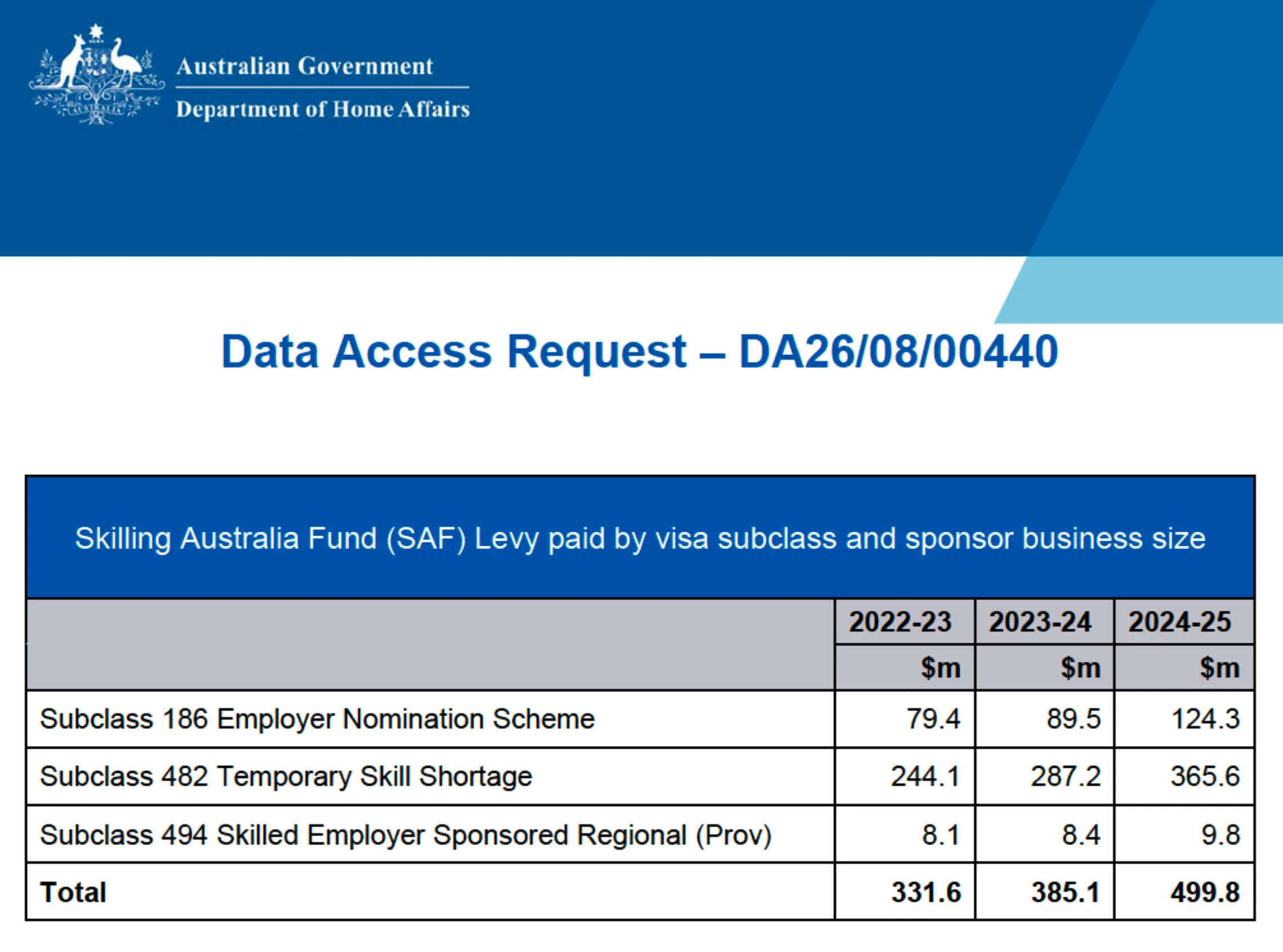
Subclass 482 visas raised about 73% of the 2024–25 total. These figures count valid applications only, and leave out visa application charges, nomination fees and sponsorship fees*.*
Our recommendation
We recommend three changes: pay monthly or later, refund the levy when a nomination or visa is refused without fraud, and exempt critical public services. We also want better public data.
A fairer levy may not cost the fund at all. When employers fear losing their money, fewer of them sponsor workers. More sponsors could mean the same, or more, revenue overall. We cannot prove this yet — but a fairer system would help employers, state governments, regional communities and workers alike.
What should employers do?
- Check your annual turnover, and keep records that prove it.
- Count the visa years you need — this sets your levy.
- Make sure your nomination is complete and correct. Refund grounds are very narrow.
- Budget for the full levy upfront.
If your cash flow is tight, or your sponsorship is urgent, get advice before you lodge.
Can Work Visa Lawyers help?
Yes. We help employers sponsor skilled workers and lodge strong nominations. We can assist with:
- Skills in Demand visa (subclass 482) sponsorship
- employer sponsored visas, including the 186 and 494 visas
- SAF levy calculations and refund requests
- sponsorship obligations and compliance
Early advice protects your budget and your application.
Talk to an Immigration Lawyer