

Australia is a popular destination for tourists, families and friends wanting to spend time together. Whether you are planning a holiday, visiting relatives or attending a special family occasion, you may need a visitor visa (subclass 600) before travelling to Australia.
While applying for an Australian Visitor Visa may seem straightforward, getting your application right is important.
A visa application involves more than simply completing an online form and submitting your passport. You must demonstrate that you genuinely intend to visit Australia temporarily, have sufficient financial support and will comply with your visa conditions.
The supporting documents you provide can play an important role in the outcome of your application. A well-prepared application should clearly explain your reasons for travelling, your financial circumstances and your connections to your home country.
In this guide, we explain how to apply for an Australian Visitor Visa, which documents you should prepare, how the application process works and how to avoid common mistakes that can lead to a refusal.
Visitor Visa (subclass 600) refusal: what you need to know
- Visitor Visa (subclass 600) lets eligible people visit Australia for a short time, for example for a holiday or to see family and friends.
- Not everyone needs a Visitor Visa (subclass 600). Some passport holders may use an Electronic Travel Authority (ETA, subclass 601) or an eVisitor (subclass 651) instead.
- The Department of Home Affairs must be satisfied that you intend to visit temporarily, can support yourself, meet the health and character requirements and will follow your visa conditions.
- There is no one document list for everyone. Give relevant evidence about your own circumstances. More documents do not necessarily make an application stronger.
- Most applications are made online through ImmiAccount. Use the Department’s official tools to check the current charge and processing information for your stream.
- Common reasons for refusal include weak evidence of a temporary stay, weak financial evidence, inconsistent information, past immigration problems and weak supporting documents. If your visa is refused, check the refusal notice for any review rights and deadlines.
1. What is an Australian Visitor Visa?
The Visitor Visa (subclass 600) allows eligible people to travel to Australia temporarily for tourism, visiting family and friends, or certain other permitted purposes.
Depending on the visa stream and your individual circumstances, you may be granted permission to stay in Australia for three, six or twelve months.
The most relevant streams include:
- Tourist stream: For people visiting Australia for a holiday, sightseeing or spending time with family and friends.
- Sponsored Family stream: For eligible applicants visiting family members in Australia, where an eligible Australian sponsor formally sponsors the application.
- Business Visitor stream: For people travelling to Australia for permitted business visitor activities, such as attending meetings, conferences or negotiations.
- Frequent Traveller stream: For eligible passport holders who regularly travel to Australia for business or personal reasons.
Not everyone needs a subclass 600 visa. Depending on your passport, you may be eligible for an Electronic Travel Authority (ETA) subclass 601 or an eVisitor subclass 651 instead.
It is important to check which visa is appropriate for your nationality and travel circumstances before applying.
2. Who can apply for an Australian Visitor Visa?
The Tourist stream of the Visitor Visa (subclass 600) is generally for applicants who are outside Australia when they apply and when the visa is decided.
To qualify, you must satisfy the Department of Home Affairs that you:
- Intend to visit Australia temporarily.
- Have sufficient funds, or access to sufficient funds, to support yourself during your stay and leave Australia.
- Meet the relevant health and character requirements.
- Will comply with all visa conditions.
- Have a genuine reason for travelling to Australia.
One of the most important considerations is whether you are a genuine temporary visitor.
This means the Department must be satisfied that you intend to visit Australia temporarily rather than remain in Australia beyond the period permitted by your visa.
Your personal circumstances, employment, financial position, family commitments, previous travel history and immigration history may all be relevant to this assessment.
It is therefore important to consider your overall circumstances when preparing your application rather than focusing on just one requirement.
3. What documents do you need for an Australian Visitor Visa?
The documents you provide can have a significant impact on the outcome of your application.
There is no single document checklist that suits every applicant. Your supporting documents should reflect your personal circumstances, financial position and reasons for travelling to Australia.
The following checklist provides examples of documents that may be relevant to your application.
You do not necessarily need to provide every document listed. The most important thing is to provide relevant evidence that supports the information in your application.
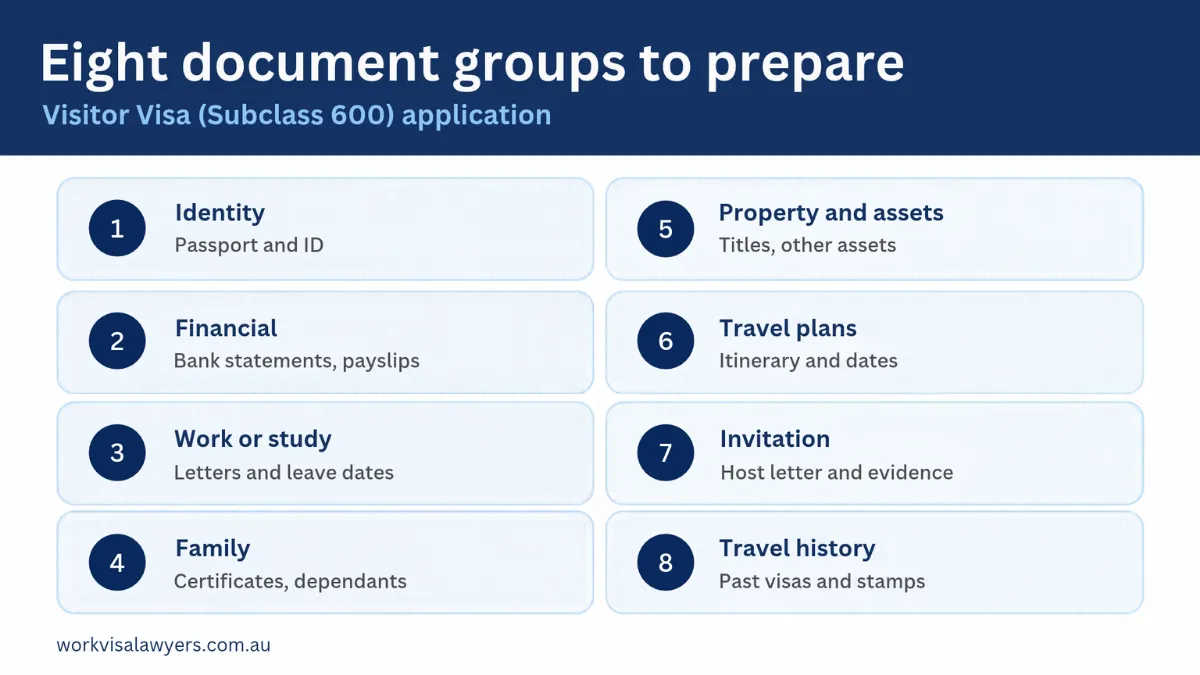
A. Identity documents
You should provide documents that establish your identity and confirm your personal details.
These may include:
- A valid passport showing your photograph and personal details.
- Copies of relevant passport pages, including previous visas and entry and exit stamps.
- A national identity card, if applicable.
- Birth certificate, where relevant.
- Marriage certificate or divorce certificate, if applicable.
- Evidence of any legal name changes.
- Previous passports, particularly if they contain relevant travel history.
Make sure your personal details are consistent across your application and supporting documents.
B. Financial documents
You must demonstrate that you can financially support yourself during your proposed stay in Australia or have access to sufficient financial support.
Depending on your circumstances, financial evidence may include:
- Recent personal bank statements, ideally covering approximately the previous three months.
- Recent payslips.
- Employment income records.
- Tax returns or tax assessments.
- Term deposit statements.
- Evidence of personal savings.
- Evidence of other accessible funds.
- Business financial statements, if you are self-employed.
- Evidence explaining any significant or unusual deposits into your bank account.
If someone in Australia will be paying for your accommodation, travel or living expenses, you should explain this in your application and provide evidence of their financial capacity.
For example, if your daughter is inviting you to stay with her in Adelaide and will cover your accommodation and daily expenses, you could provide:
- Your daughter’s recent bank statements.
- Her employment confirmation letter.
- Her recent payslips.
- Evidence of her Australian citizenship or permanent residence, where applicable.
- A written statement explaining which expenses she intends to cover.
Importantly, financial support from a family member does not automatically establish that you are a genuine visitor. Your own financial circumstances and reasons for returning home remain important.
C. Employment, business and other commitments overseas
Your employment and other ongoing commitments can help demonstrate that you have reasons to return to your home country after visiting Australia.
Depending on your circumstances, relevant documents may include:
If you are employed:
- An employment confirmation letter identifying your position, salary and length of employment.
- A letter confirming your approved leave dates.
- Confirmation of your expected return-to-work date.
- Recent payslips.
- Employment contracts, where relevant.
If you operate a business or are self-employed:
- Business registration documents.
- Business ownership certificates.
- Business licences, where applicable.
- Recent business activity records.
- Business financial statements.
- Tax returns or business tax records.
- Evidence of ongoing contracts, projects or upcoming business commitments.
If you are studying:
- School, college or university enrolment confirmation.
- Evidence of your current course or study program.
- Academic records, where relevant.
- Confirmation of your expected return to study.
These documents can help demonstrate that you have ongoing professional, business or educational commitments outside Australia.
D. Family and personal circumstances
Your family circumstances may also be relevant when assessing whether you intend to return home.
Examples of supporting documents include:
- Birth certificates demonstrating family relationships.
- Marriage certificate.
- Birth certificates of dependent children.
- Evidence of children attending school in your home country.
- Documents demonstrating responsibility for dependent family members.
- Evidence of immediate family members who remain in your home country.
- Other documents demonstrating ongoing family responsibilities.
E. Property and assets
Property ownership and other significant assets may provide further evidence of your financial and personal connections to your home country.
Depending on your circumstances, you may provide:
- Property title documents.
- Land ownership certificates.
- Property purchase agreements.
- Mortgage statements, where relevant.
- Evidence of rental income from investment properties.
- Documents demonstrating ownership of other significant assets.
Property ownership alone does not guarantee that a Visitor Visa (subclass 600) will be granted. However, it may form part of the overall evidence of your circumstances outside Australia.
F. Travel plans and purpose of visit
You should clearly explain why you want to visit Australia and what you intend to do during your stay.
Relevant supporting documents may include:
- A proposed travel itinerary.
- Intended arrival and departure dates.
- Proposed accommodation arrangements.
- Details of the relatives or friends you intend to visit.
- Evidence of planned family gatherings or special occasions.
- Wedding invitations or event confirmations, where applicable.
- Proposed return travel arrangements.
Your proposed travel plans should be realistic and consistent with the information provided in your application.
You do not necessarily need to purchase non-refundable flights before your visa is granted. It is generally sensible to wait until you have received your visa before making firm travel commitments.
G. Invitation and sponsorship documents
If you are visiting family or friends in Australia, an invitation letter can help explain the purpose of your trip and your relationship with the person you intend to visit.
Your Australian host may provide:
- An invitation letter explaining the purpose and intended duration of your visit.
- Evidence of their relationship with you, such as birth certificates or marriage certificates.
- A copy of their Australian passport or citizenship certificate, if applicable.
- Evidence of Australian permanent residence or their current visa status.
- Evidence of their residential address, such as a utility bill or lease agreement.
- Details of the accommodation they will provide.
- Bank statements, if they will financially support your visit.
- Employment confirmation and payslips, if relevant.
The invitation letter should clearly identify the person inviting you, explain your relationship, outline the reason for your visit and confirm how long you intend to stay.
If your Australian host is providing accommodation or financial assistance, this should also be clearly explained.
An invitation letter is supporting evidence, not a guarantee of visa approval. The Department will still consider your own circumstances and whether you genuinely intend to visit Australia temporarily.
H. Previous travel and immigration history
Your previous travel and immigration history may also be relevant to your application.
Depending on your circumstances, you may provide:
- Copies of previous visas.
- Entry and exit stamps in previous passports.
- Evidence of previous international travel.
- Previous Australian visa grant notifications, if applicable.
- Previous visa refusal notifications, where relevant.
- Explanations and supporting documents relating to previous visa refusals, overstays or breaches of visa conditions.
If you have previously travelled internationally and complied with the conditions of your visas, your travel history may help demonstrate that you have respected immigration requirements.
You must also disclose relevant previous visa refusals and immigration issues truthfully.
Important document preparation tips
Before submitting your application, consider the following:
- Ensure your documents are clear, complete and legible.
- Check that the information in your documents is consistent with your application form.
- Provide English translations of documents that are not in English, in accordance with the Department’s translation requirements.
- Explain any unusual financial transactions or significant deposits.
- Avoid submitting large volumes of irrelevant documents.
- Organise your documents into clearly labelled categories.
- Include a covering letter where it would help explain your circumstances and connect the supporting evidence.
Remember, submitting more documents does not necessarily make an application stronger. The focus should be on providing relevant evidence that addresses the visa requirements and supports your individual circumstances.
4. How to apply for an Australian Visitor Visa
Most Visitor Visa (subclass 600) applications are lodged online through the Department of Home Affairs’ ImmiAccount system.
Here is a step-by-step overview of the application process.
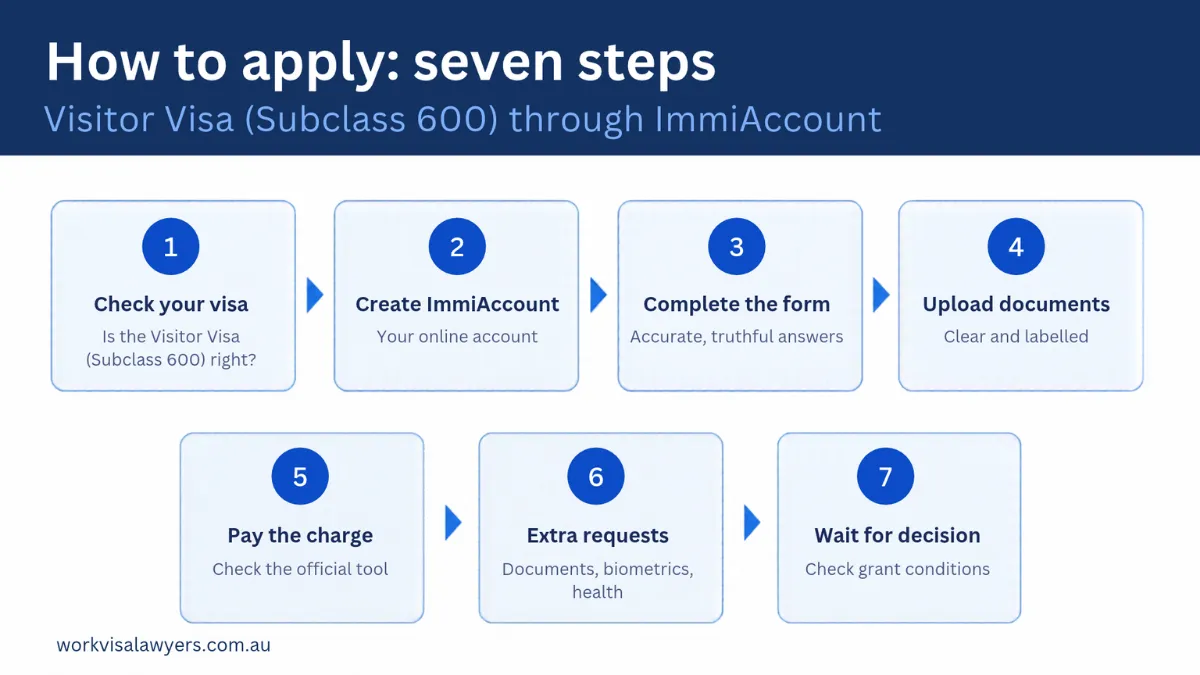
Step 1: Check which visa you need
Before starting your application, check whether you need a Visitor Visa (subclass 600), ETA or eVisitor.
If you are applying for a subclass 600 visa, identify the correct stream based on your travel purpose and circumstances.
Step 2: Create an ImmiAccount
Visit the Department of Home Affairs website and create an ImmiAccount.
You will use this account to:
- Complete your visa application.
- Upload supporting documents.
- Pay the visa application charge.
- Receive correspondence from the Department.
- Respond to requests for further information.
- Check your application status.
Step 3: Complete the application form
Provide accurate information about your identity, travel history, employment, financial circumstances, family relationships and intended visit to Australia.
Take care when answering questions about previous visa refusals, immigration history and criminal history.
You must disclose relevant information truthfully, even if you think it may negatively affect your application.
Step 4: Upload supporting documents
Upload your passport and supporting evidence to demonstrate that you meet the visa requirements.
Organise your documents clearly and ensure that any documents not in English are accompanied by appropriate English translations.
It is also helpful to provide a covering letter explaining your circumstances, the purpose of your visit and how the supporting documents address the relevant visa requirements.
Step 5: Pay the visa application charge
The application charge depends on the visa stream and your circumstances.
At the time of writing in November 2026, the Department’s Visitor Visa information lists the offshore Tourist stream application charge from AUD $250.
However, visa charges can change. Applicants should confirm the applicable amount using the Department’s official Visa Pricing Estimator before lodging.
Step 6: Complete any additional requirements
After lodging your application, the Department may request:
- Additional supporting documents
- Biometrics
- Health examinations
- Further information about your circumstances
Check your ImmiAccount and email regularly so you do not miss important correspondence or deadlines.
Step 7: Wait for the visa decision
The Department will assess your application and notify you of the outcome.
If your visa is granted, carefully check the grant notification for:
- Your permitted stay period.
- The visa expiry date or last date to arrive, where applicable.
- The number of permitted entries.
- Any conditions attached to your visa.
5. How long does an Australian Visitor Visa take to process?
Processing times vary depending on the applicant’s circumstances, the visa stream, the location processing the application and the amount of supporting information provided.
The Department of Home Affairs publishes processing time information through its online Visa Processing Times Guide.
Importantly, the general Visitor visa processing figure can be misleading because it combines subclasses 600, 601 and 651. The ETA and eVisitor applications can be processed much faster than some subclass 600 applications.
Applicants should therefore check the processing information for their specific subclass 600 stream rather than assume that the overall Visitor visa median applies to their application.
We recommend applying well before your intended travel date and providing all relevant documents when lodging your application.
There is no guaranteed processing timeframe, even where an applicant has previously been granted an Australian Visitor Visa.
6. Common reasons an Australian Visitor Visa may be refused
A Visitor Visa (subclass 600) refusal can be disappointing, particularly when the applicant is hoping to visit close family members.
Understanding some of the common reasons for refusal can help you prepare a stronger application.
Insufficient evidence of genuine temporary stay
The Department may not be satisfied that the applicant intends to stay in Australia temporarily.
For example, an applicant who has limited employment, family or financial commitments in their home country may need to provide further evidence explaining why they will return.
Inadequate financial evidence
An applicant may have insufficient funds to support their proposed stay, or the source of their funds may not be adequately explained.
Large deposits shortly before lodging an application can also raise questions if there is no clear explanation of where the money came from.
Inconsistent information
Differences between the application form, invitation letter, financial documents and travel plans can undermine the credibility of an application.
For example, if the applicant states that they intend to visit for three weeks but their supporting documents suggest a six-month stay, the discrepancy should be explained.
Previous immigration history
Previous visa refusals, overstays or breaches of visa conditions may be relevant to the assessment.
These matters should be addressed openly and supported by appropriate explanations and evidence.
Weak supporting documents
Simply providing an invitation letter from an Australian family member is not enough.
The applicant must also demonstrate their own circumstances and explain why the proposed visit is temporary.

7. Can I work or study on an Australian Visitor Visa?
A Visitor Visa (subclass 600) is not a work visa.
You cannot work in Australia while holding a Visitor Visa, even if you are waiting for the outcome of another visa application.
You may generally undertake study or training for up to three months, subject to the conditions of your visa.
If your primary intention is to work or study for longer than three months, you should explore the appropriate visa options before travelling.
Always check the conditions attached to your particular visa grant.
8. What happens if my Visitor Visa is refused?
If your application is refused, the Department will provide a decision notification explaining the reasons for refusal.
Depending on the circumstances and the decision, you may have access to merits review. However, review rights are not available in every case, and eligibility may depend on factors such as the applicant’s location and visa circumstances.
It is important to check the refusal notification carefully, including any review rights and strict deadlines.
A new application may be possible, but simply lodging another application with the same documents is unlikely to address the concerns that led to the original refusal.
Before reapplying, consider:
- Identifying the specific reasons for refusal.
- Addressing any concerns about your intention to return home.
- Providing stronger financial evidence.
- Correcting inconsistencies or missing information.
- Explaining any relevant immigration history.
Obtaining professional advice can help you understand your options before taking further action.

9. Example of a well-supported Australian Visitor Visa application
Understanding which documents you need is one thing. Knowing how those documents work together to support your application is equally important.
Consider the following example.
Example: A mother visiting her daughter in Australia
An applicant lives overseas and wants to visit her daughter, who is an Australian permanent resident living in Adelaide.
The applicant intends to stay for six weeks to spend time with her daughter and grandchildren.
Her daughter has offered to provide accommodation and cover some of her living expenses.
Rather than relying solely on her daughter’s invitation letter, the applicant should provide evidence addressing her personal circumstances, financial position, family connections and reasons for returning home.
The application could include the following documents:
| Supporting document | What it helps demonstrate |
|---|---|
| Applicant’s passport | Identity and travel details |
| Daughter’s invitation letter | Purpose and intended duration of the visit |
| Daughter’s permanent residence evidence | Host’s immigration status in Australia |
| Birth certificates | Relationship between mother and daughter |
| Daughter’s bank statements | Financial capacity to support the visit |
| Daughter’s employment letter and payslips | Source of financial support |
| Applicant’s bank statements | Applicant’s own financial circumstances |
| Applicant’s employment confirmation | Ongoing employment overseas |
| Approved leave letter | Intention to return to work |
| Property ownership documents | Financial and personal ties overseas |
| Evidence of other family members overseas | Ongoing family connections |
| Proposed travel itinerary | Intended activities and duration of stay |
| Evidence of accommodation arrangements | Where the applicant will stay |
How do these documents strengthen the application?
The documents should not simply be uploaded without explanation. They should work together to present a consistent and credible account of the applicant’s circumstances.
For example:
1. Establishing the purpose of the visit
The daughter’s invitation letter should explain why her mother wants to visit, their relationship and how long she intends to stay.
The birth certificates can help establish the family relationship, while the daughter’s permanent residence evidence confirms her status in Australia.
2. Demonstrating financial support
The daughter should explain which expenses she will cover, such as accommodation and daily living expenses.
Her bank statements, employment confirmation and payslips can help demonstrate that she has the financial capacity to provide the proposed support.
The applicant should also provide her own financial documents, where available, rather than relying entirely on the Australian host.
3. Demonstrating reasons to return home
The applicant’s employment confirmation and approved leave letter can demonstrate that she has ongoing employment commitments and is expected to return to work after her visit.
Property ownership documents and evidence of other family members remaining overseas can provide further information about her circumstances outside Australia.
4. Explaining the proposed travel arrangements
The proposed itinerary should be consistent with the intended six-week visit.
The application should explain where the applicant will stay, who she intends to visit and what she plans to do during her time in Australia.
The importance of a covering letter
A covering letter can be particularly useful in bringing all the evidence together.
Rather than leaving the Department to work through the documents without context, the covering letter should explain:
- The applicant’s personal and family circumstances.
- The purpose and intended duration of the visit.
- The financial arrangements for the trip.
- The applicant’s employment, property or other commitments overseas.
- Why the applicant intends to return home after the visit.
- How the supporting documents address the relevant visa requirements.
Ultimately, the objective is to demonstrate that the applicant has a genuine reason to visit Australia temporarily, has appropriate financial arrangements and intends to return home at the end of the visit.
Every application is assessed on its individual merits, and providing these documents does not guarantee visa approval. However, a clear and well-supported application gives the Department a better understanding of the applicant’s circumstances.

10. Get professional advice before lodging your visitor visa application
An Australian Visitor Visa (subclass 600) may appear simple, but a refusal can affect your travel plans and future visa applications.
A well-prepared application should clearly explain your personal circumstances, demonstrate your intention to visit temporarily and include relevant supporting evidence.
As demonstrated in the example above, the strongest applications do more than provide a collection of documents. They bring together the applicant’s financial position, family circumstances, travel purpose and reasons for returning home into a clear and consistent explanation.
If you are unsure which visa stream is appropriate, have previously been refused a visa or have complicated personal or immigration circumstances, it may be worthwhile seeking advice from a registered migration agent or Australian legal practitioner authorised to provide immigration assistance.
Need assistance with an Australian Visitor Visa?
Our team can help assess your circumstances, identify the appropriate visa pathway and assist with preparing a clear and well-supported application.
Contact us to discuss your options before lodging your application.
Book an AppointmentVisitor Visa (subclass 600) refusal: Frequently asked questions
Do I have to provide every document on the checklist?
No. You do not necessarily need to provide every document listed in this guide. The most important thing is to give relevant evidence that supports the information in your application. Providing more documents does not necessarily make an application stronger.
Does an invitation letter or my relative’s financial support guarantee a visitor visa?
No. An invitation letter is supporting evidence, not a guarantee of visa approval. Financial support from a family member does not automatically show that you are a genuine visitor. The Department still considers your own financial circumstances and your reasons for returning home.
Do I have to tell the Department about a previous visa refusal?
You must disclose relevant previous visa refusals and immigration issues truthfully. This applies even if you think the information may affect your application. Explain the issue and add supporting documents where they help. If you are unsure what to include, speak to a registered migration agent or immigration lawyer.
Can I appeal if my Visitor Visa (subclass 600) is refused?
Sometimes. Review rights are not available in every case, and they may depend on factors such as your location and your visa circumstances. Check your refusal notification straight away for any review rights and strict deadlines. A registered migration agent or immigration lawyer can help you understand your options.
Do the September 2026 changes to visitor visas affect me?
On 17 September 2026, the Minister for Home Affairs announced a No Further Stay condition for all visitor visas. The aim is that visitor visas are used only by genuine visitors and not as a way to extend a stay in Australia. The announcement does not give a start date. Check the conditions on your own visa grant.
More on visitor visa refusals, reviews and requirements
- Visitor Visa - Subclass 600
- No Further Stay condition (8503): how to extend a visitor visa in Australia
- Visa appeal and review options
- Genuine Temporary Entrant (GTE) requirements
Disclaimer: This information is general only and does not take into account your personal situation. Australian visitor visa rules, conditions and charges can change quickly. You should get advice from a registered migration agent or immigration lawyer before applying for a visa.